Get Professional Signage That Boosts Your Business Visibility, Fast & Hassle-Free!
Custom Wall Graphics · New York City
Printed and cut wall graphics for New York offices and retail spaces: vinyl decals and lettering, textured and wallpaper finishes, full wall wraps and dimensional wall signage. Most single-wall installations take a few hours to a full day and can be scheduled after hours or on a weekend, and we handle the certificate of insurance with your property manager as part of the booking.
The Basics
Wall graphics are printed or cut vinyl, wallpaper, or dimensional elements applied to an interior or exterior wall to communicate a brand, message, or design, ranging from a single logo decal to a full wall wrap. The term covers a broad category of products rather than one specific product: lettering, decals, textured wallpaper, printed wall wraps, and dimensional wall signage are all types of wall graphics.
Wall graphics are one of the fastest ways to turn a blank office, retail, or lobby wall into branded, on-message space without committing to a full architectural mural. Street Style Sign Studio designs, prints, and installs custom wall graphics and wall signage throughout New York City, from small-format decals and lettering to large wall wraps, for businesses that want something more targeted than a full room transformation.
Send us the wall, the artwork and your building, and we will tell you what the material should be and what the building will ask for.
A wall mural, by contrast, is usually a single large-scale, often photorealistic or illustrative scene designed to cover most or all of one wall as a standalone visual statement. Every wall mural is a wall graphic, but not every wall graphic is a mural: a small vinyl logo decal on a conference room wall and a floor-to-ceiling branded scene in a lobby are both wall graphics, but only the second is typically called a mural.If you already know you want a large-scale, artistic feature wall, see our dedicated wall murals page for that specific process. If you’re looking at smaller-format branding, lettering, textured finishes, or dimensional wall signage, this page covers those options.
Printed or cut vinyl, wallpaper, or dimensional elements applied to a wall to communicate a brand, message, or design.
A large-scale, often photorealistic or illustrative scene designed to cover most or all of one wall as a standalone visual statement.
What We Make
Beyond full murals, most NYC businesses choose from four categories of wall graphics.
Cut vinyl lettering and wall decals are the simplest way to add a logo, tagline, or wayfinding element to a wall without a full printed graphic. They install quickly, work well on painted drywall, and are a common choice for reception walls, conference rooms, and interior signage that needs to go up fast. Wall stickers and lettering are typically the most budget-friendly wall graphic option.
Wallpaper-style wall graphics use a textured or patterned material rather than a flat printed image, giving a wall a tactile, designed feel rather than a branded graphic look. This is a common choice when a business wants to elevate a space’s finish without a literal logo or scene on the wall.
A wall wrap is a large-format printed vinyl graphic applied edge-to-edge across a wall, similar in production to the wall wraps described on our wall murals page, just scaled and designed for a specific branding or promotional message rather than an artistic mural scene. If your project is closer to a full mural-scale wrap, our wall murals page covers that in more depth.
Dimensional wall signage adds physical depth, cut logo letters or shapes mounted off the wall, rather than a flat printed graphic. It is a common upgrade for a lobby or reception wall that wants the shadow and depth of a 3D sign rather than a flat decal. See our dimensional signs and lobby logo signs pages for more on 3D wall signage specifically.
The material decision on a leased wall is really a decision about how the job ends.
Cast or calendered vinyl, roughly 2 to 4 mil, cut on a plotter with no visible background. Removable vinyl on a smooth, sound, fully cured painted wall peels cleanly at a low angle with gentle heat and typically leaves no residue. On a freshly painted wall, or over a low-quality or matte flat paint, the risk is not adhesive residue but paint lift, because the vinyl bonds better than the paint does to the drywall. We check the paint condition and the cure time during the site survey and specify accordingly.
Wide-format printed media, installed panel by panel with overlapped or butt seams. Textured and matte finishes hide wall imperfections that a gloss vinyl amplifies. These are surface treatments, not decals: removal is a wallpaper strip, and a repaint is normal at end of lease rather than a sign that something went wrong.
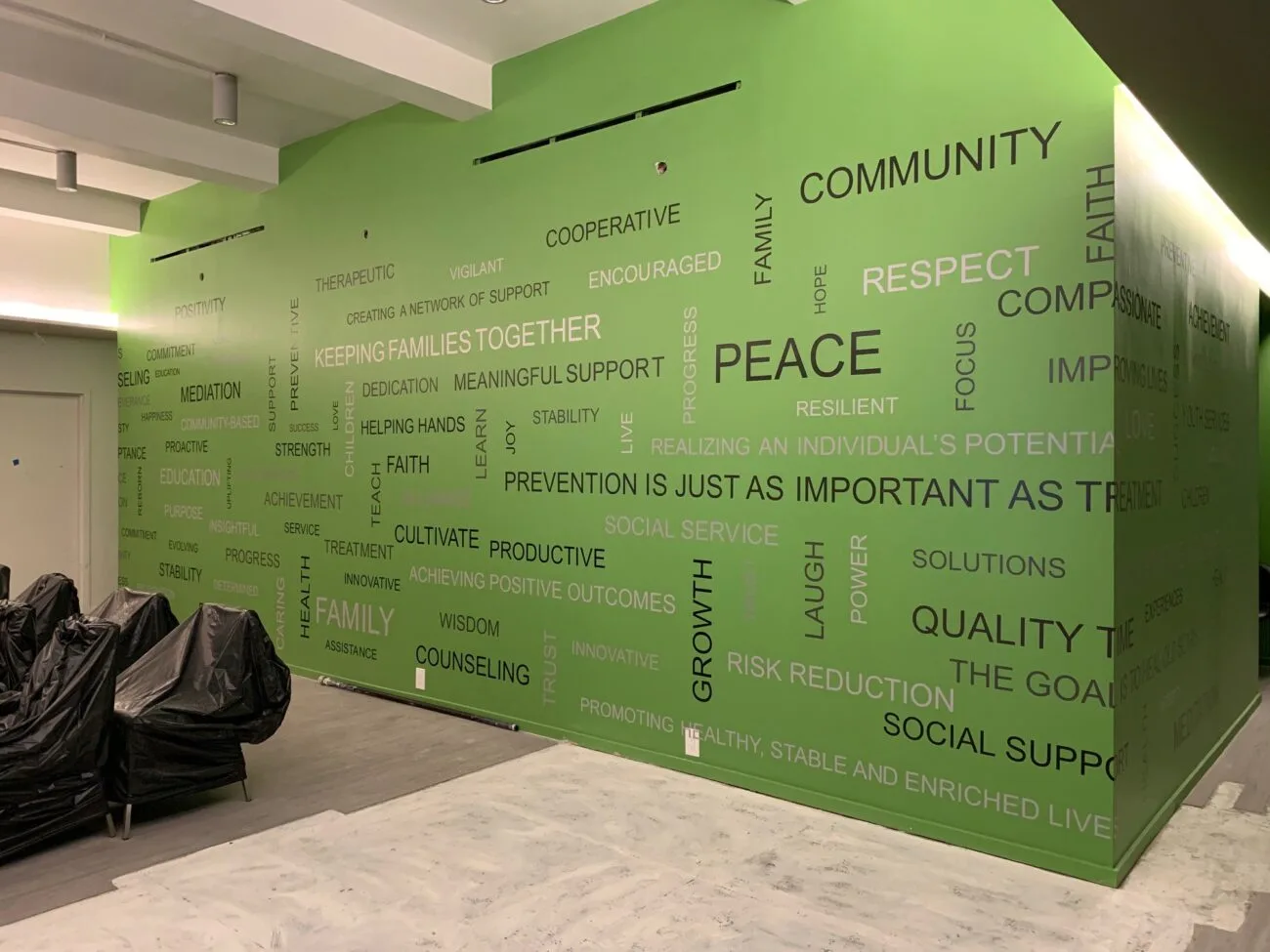
Cut acrylic, metal or PVC letters and logos, either stud-mounted into the wall or applied with a mounting tape and standoff. Stud mounting means patch-and-paint when the sign comes down; tape-applied dimensional work does not. Common applications include mission statement and core values walls.
Interior wall graphics are not exposed to weather or UV in the way storefront vinyl is, so the practical limit is not material failure but the tenancy and the brand. Interior vinyl and printed wallpaper installed on a sound surface hold their color and adhesion for years indoors, and in practice they are replaced when the branding changes or the lease ends, not because the graphic wore out.
What we need to know before specifying anything: whether the wall is painted drywall, plaster, brick, glass or a textured surface; how recently it was painted; whether the space is leased and what the lease says about wall alterations; and whether the graphic has to come off cleanly at exit. Those four answers determine the material, and they are the first four questions on the site survey.
Our Work
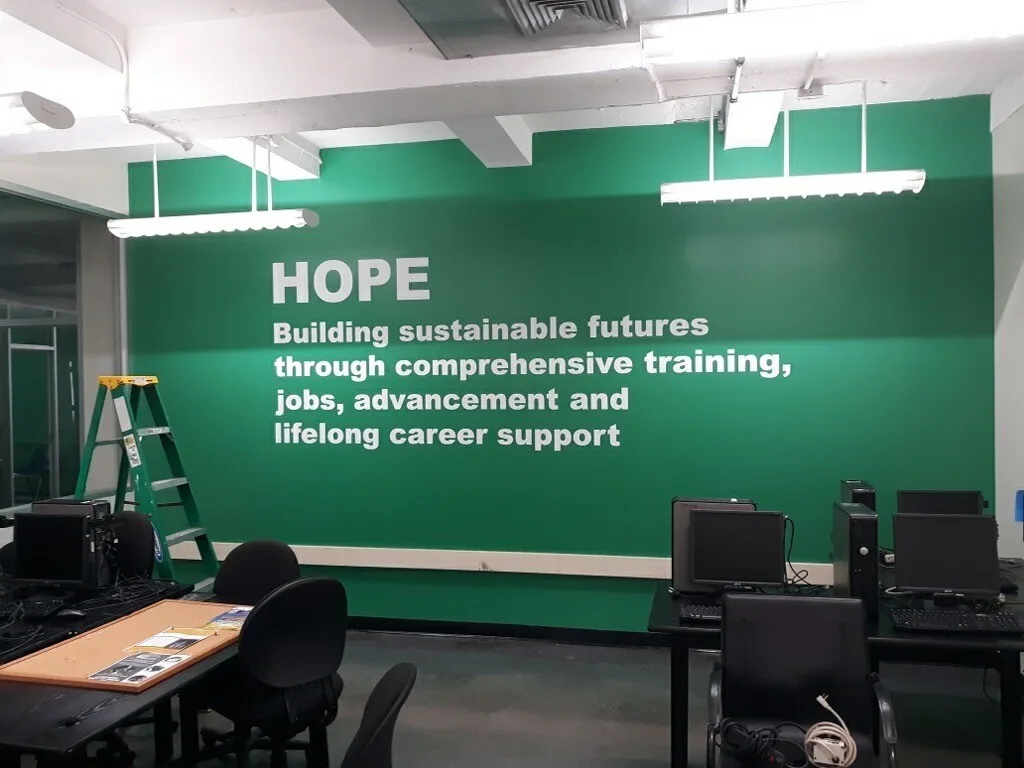
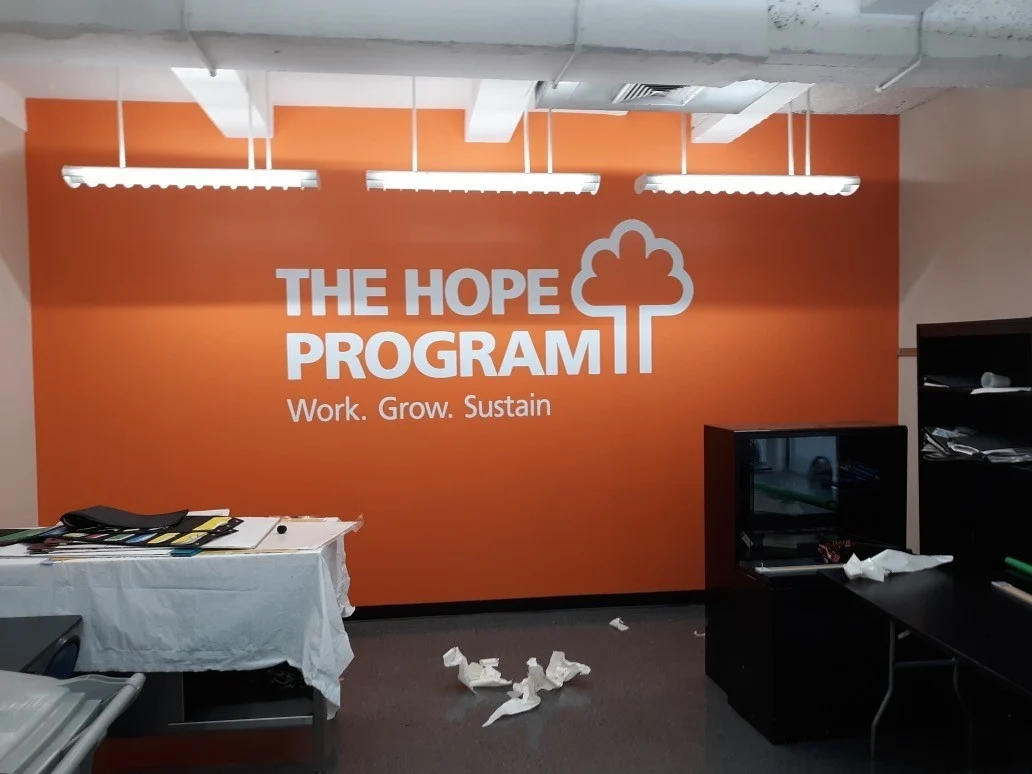
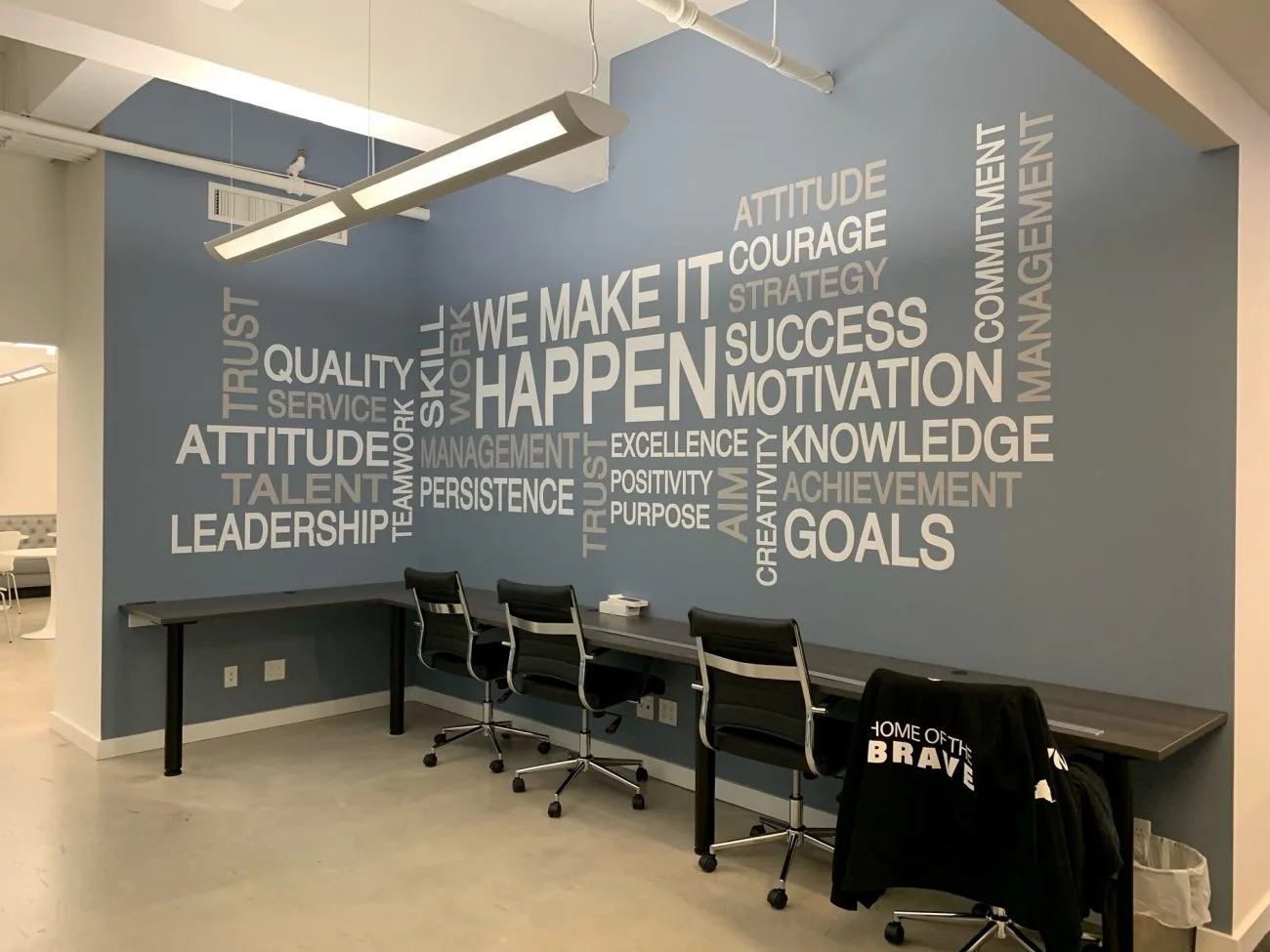
Recent office and retail wall graphics installed across Manhattan, Brooklyn and Queens. More projects are in our full signage portfolio.
Built for NYC
Installing wall graphics inside a leased NYC office is not just a design project, it is a building-logistics project, and this is where a lot of first-time buyers get caught off guard.
Most commercial landlords and property management companies require a Certificate of Insurance (COI) naming the building and management company as additional insured before any installation crew is allowed on site. We handle this paperwork directly with your property manager as part of scheduling the job, so it does not become a delay you discover the week of installation.
In many Class A and Class B office towers, freight elevator access is scheduled in advance rather than available on demand, sometimes limited to specific hours or requiring advance notice with the building’s management office. Larger materials, like wall wrap rolls or dimensional signage panels, need that freight elevator slot booked before an install date can be confirmed.
If your building is a designated NYC landmark or sits within a historic district, confirm with your property manager whether interior alterations, including large-format wall graphics, require any additional sign-off. Landmark status most often governs a building’s exterior, but some landmarked buildings apply their own review to conspicuous interior work as well, so it is worth checking rather than assuming.
From First Site Visit to Finished Wall
We visit the space to measure the wall, review the surface condition, and confirm your building’s specific COI and freight elevator rules.
We design the graphic to your specifications and recommend the right material, whether that is cut vinyl lettering, a printed wall wrap, textured wallpaper, or dimensional signage.
We submit the COI and any design approval your property manager requires, then schedule freight elevator access for the installation crew and materials.
Our team completes the work, often scheduled after hours or on a weekend to avoid disrupting an occupied office.
Contact Street Style Sign Studio for a free consultation and quote on custom wall graphics anywhere in New York City.
Wall graphics is the broad category: lettering, decals, textured wallpaper, wall wraps, and dimensional signage all applied to a wall. A wall mural is one type of wall graphic, usually a single large-scale, often photorealistic or illustrative scene covering most or all of a wall as a standalone visual statement.
Beyond full murals, the main types are cut vinyl decals and lettering, textured or wallpaper-style finishes, large-format wall wraps, and dimensional (3D) wall signage using cut letters or shapes mounted off the wall.
In most commercial NYC office buildings, yes. Landlords and property management companies typically require a Certificate of Insurance naming the building and management company as additional insured before an installation crew can access the space. We handle this paperwork as part of scheduling your installation.
Most single-wall decal, lettering, or wallpaper installations take a few hours to a full day and can typically be scheduled after hours or on a weekend to avoid disrupting an occupied office. Larger wall wraps or multi-wall projects take longer and are scoped during the design consultation.
Removable vinyl on a smooth, sound, fully cured painted wall peels cleanly and typically leaves no residue. The failure mode to watch for is not adhesive but paint lift: on a wall painted very recently, or finished in a low-quality flat paint, the vinyl can bond better than the paint bonds to the drywall, and removal takes a little paint with it. We check paint condition and cure time at the site survey and either specify a lower-tack material or recommend a printed wallpaper finish, where a repaint at end of lease is expected anyway. Printed wall wraps and wallpaper are removed like wallpaper, and a repaint afterward is normal rather than a sign of a problem.
Wall graphics is the category. A wall decal is cut vinyl with no printed background: a logo, a phrase, a set of letters applied directly to the wall. A wall wrap is printed media covering the whole surface edge to edge, so the wall itself becomes the image. A mural is a wrap whose content is a single large illustration or scene. All three are wall graphics, and the practical difference is coverage: a decal is applied to a wall you keep, a wrap replaces the wall’s appearance.
Yes, with the right material. Standard flat vinyl needs a smooth surface and will not adhere reliably to brick or heavy texture, because the adhesive only contacts the high points. For those surfaces we specify a conformable textured-wall media designed to press into the profile, or move the graphic to a mounted panel or dimensional lettering set standing off the wall. On exposed brick in a converted loft, a mounted panel is usually both cleaner and cheaper than trying to force vinyl onto the surface. We identify the wall type at the site survey before anything is quoted.