

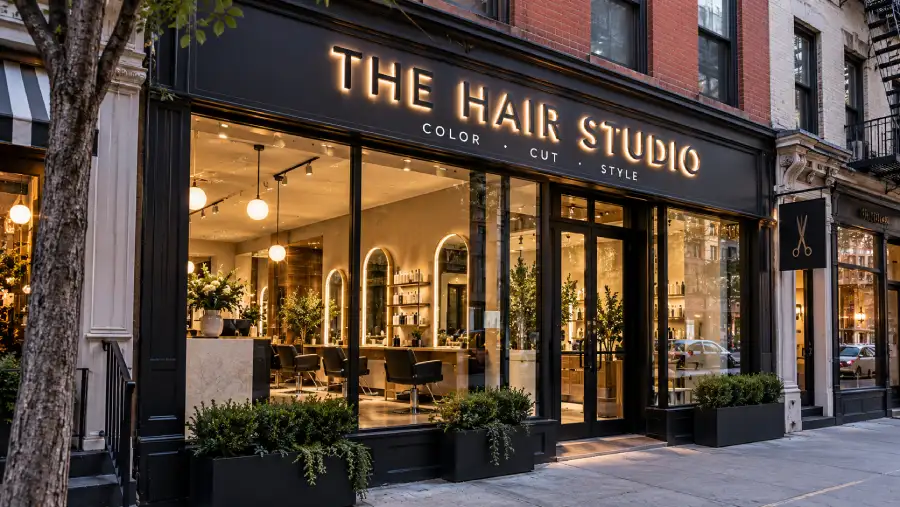
Walk one block in Manhattan or Brooklyn and you will pass a barbershop, a nail studio and a hair salon before you reach the corner. Most of them do good work. The ones that stay busy tend to make three things obvious from the sidewalk: what they do, whether you can walk in, and roughly what it costs once you are inside.
Salon and barbershop signs in NYC work in three zones: the storefront that stops people on the sidewalk, the windows and entrance that answer their first questions, and the interior signs that guide a client from the front desk to the styling station. Each zone calls for different materials. The outside also comes with city rules: a lit sign over the door almost always needs a Department of Buildings permit, and New York State requires certain notices at the entrance of licensed salons and barbershops.
This guide covers what we look at when we plan signage for a beauty business in New York City, from the façade down to the name plate on a barber’s mirror, so you can budget for the right pieces in the right order.
Key Takeaways
- Plan salon and barbershop signs in three zones: storefront, windows and entrance, and interior.
- In NYC, a business sign needs a DOB permit unless it is painted directly on the building, or is under six square feet and unlit. A lit barber pole mounted outside does not fit that exemption.
- New York State requires your licenses to be posted where clients can see them, and appearance enhancement businesses must post a state-supplied notice at the entrance.
- Barbershops usually sell walk-in speed; salons usually sell an appointment and an experience. Your signs should make clear which one you are.
- Choose materials that tolerate humidity, hairspray and daily disinfecting. Acrylic, metal and laminated vinyl hold up; paper does not.
Table of Contents (use the site’s auto TOC block)
- Start at the curb: storefront signs for salons and barbershops
- NYC rules that affect salon and barbershop signs
- Barbershop signs vs. salon signs: what each one needs to say
- Window graphics for salons and barbershops
- The notices New York State requires you to display
- Interior salon signs: from reception to the styling station
- Materials that hold up in a salon
- A sign plan for opening a salon or barbershop in NYC
- Frequently Asked Questions About Salon and Barbershop Signs in NYC
- Planning signs for your salon or barbershop
Start at the curb: storefront signs for salons and barbershops
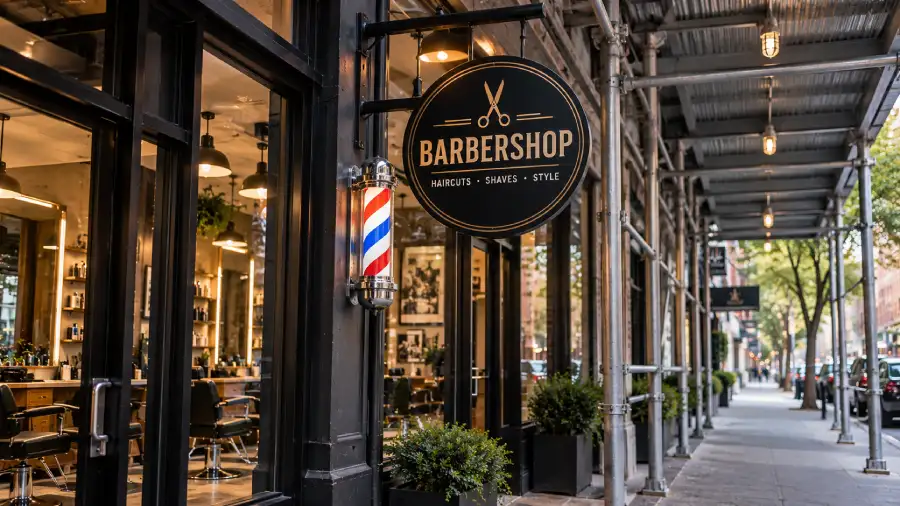
Most people decide whether to step into a salon in the few seconds it takes to walk past it. In New York those seconds are crowded. There is a deli awning on one side, a phone repair shop on the other, and quite often a sidewalk shed covering half the block.
Your main exterior sign has one job: say your name and what you do, clearly enough to read from across the street. For most beauty businesses that means one of these formats:
- Dimensional letters: individual cut letters in acrylic, metal or PVC mounted to the façade. They look clean and upscale, and they pair well with halo lighting. Halo-lit letters have LEDs mounted behind each letter that wash the wall with light, so the letters read as a crisp silhouette at night.
- Channel letters: fabricated letters with LEDs inside and a translucent face. They are brighter than halo lighting and easier to read from a distance after dark, which suits barbershops that stay open late.
- Blade signs: two-sided signs that project from the building. On a narrow NYC frontage this is often the sign people actually notice, because pedestrians look up and down the block rather than straight at the façade.
- Awning lettering: your name and service on the awning valance, useful when the fascia above the door is short or broken up by the building’s architecture.
One issue is specific to this city: sidewalk sheds. If your building has scaffolding, or is likely to get it during façade work, a fascia sign can disappear for months. A blade sign mounted below the shed line, or strong window graphics at eye level, keeps you visible in the meantime. We ask about scaffolding plans before we recommend any exterior layout, because it changes which sign earns the budget.
If you want to compare the main exterior options side by side, our page on storefront signs in NYC covers dimensional letters, window graphics, blade signs and banners in more detail, with photos of installed projects.
NYC rules that affect salon and barbershop signs
This is the part most design-inspiration articles skip, and it is usually where opening dates slip.
A DOB sign permit is required to install a business sign in New York City unless the sign is painted directly onto the building, or is smaller than six square feet in total area and unlit, according to the NYC Department of Buildings. Six square feet is small: a 2 ft by 3 ft panel. Almost any real storefront sign is over that line, and any lit sign fails the exemption regardless of size.
That second condition matters for barbershops. A rotating, lit barber pole mounted on the outside of the building counts as a lit sign, so it does not qualify for the small-sign exemption. The same goes for a halo-lit logo, however compact.
Who installs the sign is regulated too. Master Sign Hangers are licensed by DOB to hang signs of any size or weight. Special Sign Hangers can hang signs no larger than 150 square feet that weigh no more than 1,200 pounds. A registered general contractor can install unlit business signs with a limited amount of text, and larger or heavier signs may need drawings from a New York State registered architect or professional engineer.
Size and placement are governed by the NYC Zoning Resolution, which treats your storefront sign as an accessory sign and sets limits based on your zoning district. The same sign can be fine on one avenue and too large two blocks away, so look up your district on the Department of City Planning’s zoning map before you fall in love with a design. Two more rules apply everywhere: electrical work for lit signs has to follow the NYC Electrical Code, and no sign may block a fire escape, window or door used as a means of egress (NYC Building Code, Appendix H).
Our practical advice: before you approve a design, ask whoever is building it who files the permit, who holds the sign hanger license, and how long approvals are taking right now. Then put the exterior sign first on your schedule, because it has the longest lead time of anything on this list.
Barbershop signs vs. salon signs: what each one needs to say
Salons and barbershops share the same sidewalks, but they sell different things, and the signs should reflect that.
A barbershop usually sells speed and routine. Plenty of clients walk in, so the most useful exterior messages are practical ones: walk-ins welcome, today’s hours, and a phone number big enough to read from the curb. Inside the door, a simple wait-time board or a sign explaining how the queue works saves the front chair a lot of repeated questions. Type tends to be bold and high-contrast. Script lettering, a classic pole and a black, red or gold palette all read as “barbershop” to a New Yorker at a glance, which is exactly the point.
A hair salon, nail studio or brow bar usually sells an appointment and an experience. The exterior sign can be quieter (halo-lit letters, or a single logo on the glass) because most booking happens online. The window then has to do a different job: answer “what do you do here?” with a short services line, and give people a booking QR code they can scan without stopping.
Hybrid shops and salon suites need a third approach. When several independent stylists or barbers rent chairs or suites in one space, a directory sign at the entrance and a name plate at each station help clients find their person without crowding the front desk. It also gives each renter a bit of their own branding, which matters to them when they are deciding where to rent.
If you run a beauty business and want to see what we make for this industry specifically, our custom salon signs page shows salon projects and the sign types we produce most often.
Window graphics for salons and barbershops
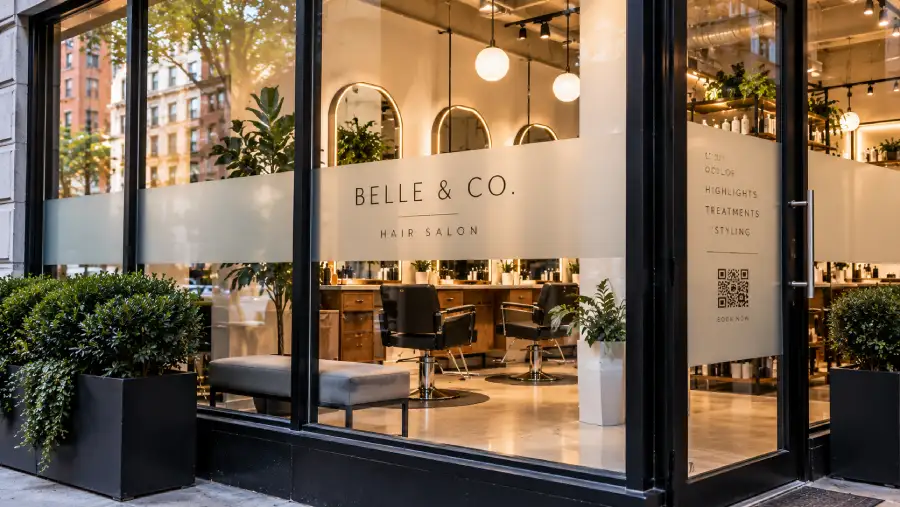
Windows do more work per dollar than any other surface on a NYC storefront. Beauty businesses also have a problem most retailers don’t: clients sit in a chair facing the glass, sometimes with foil in their hair or a mask on their face. Nobody wants to be part of the street view during a color appointment.
These are the privacy options we recommend most for salons:
- Frosted vinyl band: a strip of frosted or etched-look film at the height of a seated client’s head and shoulders. Light still comes in, and from the street people see a clean band, often with your logo cut out of it.
- Perforated window film, also called one-way vision vinyl: printed film full of tiny holes. From outside you see the printed image, and from inside, in daylight, clients can still see out. The effect depends on light, so it works best when it is brighter outside than in. After dark, with the salon lights on, people outside can see in more easily.
- Window privacy film for treatment rooms (waxing, facials, lashes) where full privacy matters more than daylight.
Then there is the information layer. The glass next to the door is where people look for hours, phone number, Instagram handle and a booking link. Put those at standing eye level on the door side, in letters you can read from the curb, and keep them separate from your decorative graphics so they don’t get lost.
Seasonal promotions (holiday gift cards, prom and wedding season, back-to-school cuts) work best as removable vinyl, so you can swap them without touching the permanent branding. Our window graphics page shows the film types we print, and our post on a seasonal window graphics strategy covers planning a year of window changes.
The notices New York State requires you to display
This is the signage nobody photographs for Instagram, but inspectors and clients look for it.
Under New York General Business Law, a business licensed for appearance enhancement (cosmetology, nail specialty, esthetics, waxing or natural hair styling) must post its license certificate in a conspicuous place on the premises. It must also post a sign at the entrance that includes the rules governing the practice and how clients can file a complaint, and the Department of State prepares and supplies that sign (GBL § 408). Barbershops have their own version: the barber shop owner’s license must be displayed in the shop, and each barber’s license or apprentice certificate must be posted in a conspicuous place where that person works (GBL §§ 437 to 439).
You can’t redesign the state’s notice, but you do decide how it sits on your wall. A set of matching acrylic frames or standoff-mounted holders by the front desk looks deliberate, survives daily wiping, and makes it easy to swap certificates at renewal time. Paper taped behind the register looks like an afterthought, and it tends to vanish behind product displays. Rules and forms can change, so confirm the current requirements with the NYS Department of State’s Division of Licensing Services before you open.
Interior salon signs: from reception to the styling station
Once a client is inside, signs stop selling and start guiding. The goal is a space where nobody has to ask where to wait, what something costs or which chair is theirs.
Reception and logo wall
The front desk is where the brand from the street should show up again. A reception sign in dimensional acrylic or brushed metal behind the desk confirms clients are in the right place and gives them something to photograph. If you are torn between finishes, our comparison of acrylic, metal and lit lobby signs applies to salons as much as to offices.
Service and price menu
Barbershops benefit most from a printed menu board near the entrance or waiting area, because clients like to know what a fade or a beard trim costs before they sit down. Build it so prices can change without a reprint of the whole board: changeable inserts in an acrylic frame, or vinyl lettering on a removable panel instead of directly on the wall. Digital screens are an option, though a printed board never needs a software update or a power outlet.
Styling station signs
This is where the “styling station” in our title comes in. Station signage is the small set of signs at each chair: a stylist name plate on the mirror frame, a QR code so a happy client can rebook before they leave, and in booth-rental shops, a small decal with the stylist’s own handle. Keep anything on the mirror itself to the top edge or a corner. Vinyl in the middle of the glass gets in the way of the one thing the mirror is for, which is the client checking their cut.
Feature wall
A wall mural or printed wall graphic behind the chairs or near the entrance ends up as the background in a lot of client photos, which is free marketing if it carries your name. A short neon-style script line is the most common choice for salons. We usually recommend LED neon flex over glass neon for this: it runs cooler, uses less power and is far less fragile in a busy room.
Restrooms and back of house
Restroom signs need to meet ADA requirements, including raised characters and Braille. Our ADA signs cover restrooms, exits and staff-only rooms. Simple door signs for treatment rooms and color or chemical storage keep clients out of spaces they shouldn’t wander into.
Materials that hold up in a salon
Salons are hard on signs. The air near the shampoo bowls is humid, hairspray and dry shampoo leave a sticky film on every surface, and stations get wiped with disinfectant many times a day. A sign that looks great at the opening can look tired in six months if the material is wrong.
Here is what we recommend for beauty spaces:
- Acrylic for menus, name plates and license frames. Clean it with mild soap, water and a soft cloth. Avoid ammonia-based glass cleaners, which can cause fine cracking (crazing) in acrylic over time.
- Brushed aluminum or other metal for high-touch spots near the door and the front desk, since it tolerates frequent cleaning.
- Laminated vinyl for wall, mirror and window graphics. The clear overlaminate protects the print from chemicals and scrubbing.
- Nothing paper near sinks, color stations or the shampoo area.
Outside, the usual NYC concerns apply: UV fading on south-facing storefronts, and salt and slush splashing the lower glass every winter. Our post on which materials are best for outdoor business signs goes into more detail.
A sign plan for opening a salon or barbershop in NYC
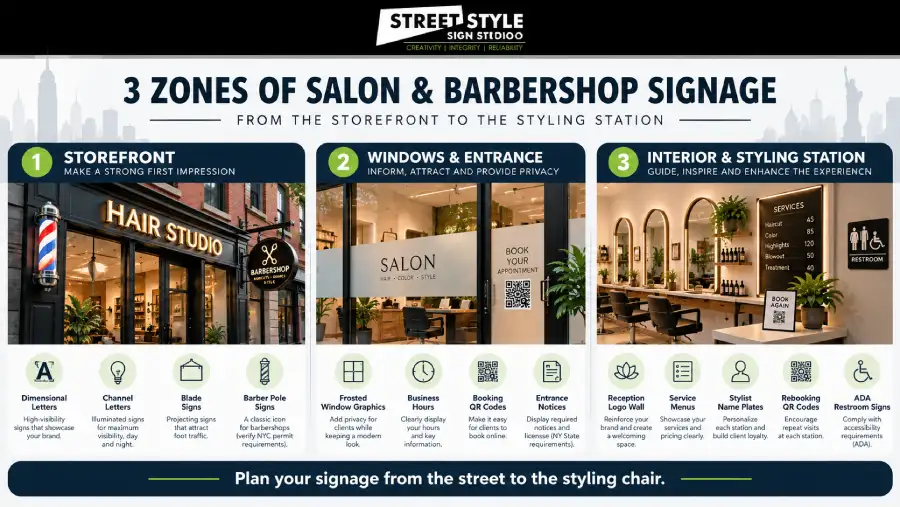
If you are opening a new location, order matters more than budget. Spending well on the wrong item first is how shops end up open for weeks with a bare façade. This sequence works for most of the beauty businesses we work with:
- Exterior sign first. Design, permit, fabrication and installation, in that order. It has the longest lead time.
- Something on the glass while you wait. Window graphics announcing your opening date and booking link start building a waitlist before the main sign is up. If you want a banner on the outside of the building, ask about permit rules first.
- Windows and door. Hours, contact details, privacy film and the state-required notices.
- Interior wayfinding. Reception sign, price menu, station plates and restroom signs.
- Feature wall last, once you know how the room photographs in real light.
If you are rebranding an existing shop rather than opening a new one, the same order applies. You may be able to put new faces on an existing sign cabinet instead of replacing the whole structure, which can save time and cost. Our post on whether to reface or replace your signage explains the trade-off.
Frequently Asked Questions About Salon and Barbershop Signs in NYC
Do I need a permit for a salon sign in NYC?
In most cases, yes. The NYC Department of Buildings requires a permit for a business sign unless it is painted directly on the building, or is smaller than six square feet and unlit. The sign must also be installed by the right licensed professional, usually a Master or Special Sign Hanger.
Does a barber pole need a permit in NYC?
A lit, rotating barber pole mounted outside generally does. The small-sign exemption only covers signs that are under six square feet and unlit, and a pole with built-in lights fails that test. Confirm the details for your building with DOB or your sign installer before you mount it.
What signs does a barbershop need?
At minimum, an exterior identification sign, hours and walk-in information on the door or window, your posted shop and barber licenses, and ADA-compliant restroom signs. Most barbershops also benefit from a price menu board near the entrance and station name plates if barbers rent chairs.
How big should my salon storefront sign be?
It depends on your zoning district, your frontage and how far away people will read it. Zoning sets the maximum size, so check your district first. A sign-industry rule of thumb is about one inch of letter height for every ten feet of viewing distance, so letters meant to be read from across an avenue need to be several inches tall.
How can a salon get window privacy without blocking natural light?
Use a frosted vinyl band at seated head height, or perforated one-way vision film. Both let daylight in while blocking the street’s view of clients in the chair. Keep in mind that perforated film is less private at night, when the salon is brighter than the street.
How long does it take to get salon signs made in NYC?
Interior pieces like menus and name plates are usually the quickest. The exterior sign takes longest because it needs design approval, a DOB permit and fabrication before installation. Plan the exterior sign weeks ahead of your opening date, not days.
Planning signs for your salon or barbershop
We design, print and install signs for beauty businesses across the five boroughs, Yonkers and New Rochelle from our studio on East 24th Street in Manhattan. If you are opening or refreshing a shop, send us a few photos of your façade and a rough floor plan, and we will suggest what to do first and what can wait.
You can see examples of our beauty industry work on our salon signs in NYC page, browse the signage portfolio, or request a free quote when you are ready.