

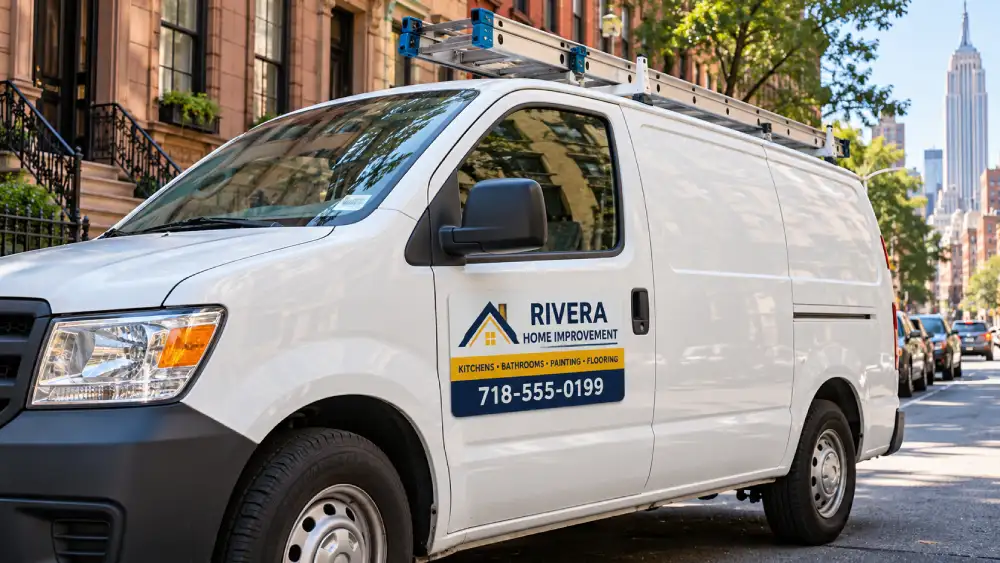
Key Takeaways
- Magnetic vehicle signs fit NYC contractors whose vehicles do double duty: personal cars driven to jobs, leased vans, and overflow vehicles during busy season.
- For NYC commercial parking, the current Traffic Rules say the registrant’s name must be permanently affixed in 3-inch letters on both sides. A magnet is a weak bet for that, so put the required name in permanent vinyl and use magnets for the marketing.
- A NYC DOT proposal would replace that wording with the federal marking standard, which allows removable signs. As of October 2026 it is still a proposed rule, so plan around the current one.
- If you hold an NYC Home Improvement Contractor license, DCWP requires the license number in your advertising. Print it on the magnet.
- Magnets only hold on steel. Aluminum-body trucks like the Ford F-150 need lettering or a wrap instead.
Most NYC contractors don’t need a full wrap on day one. They need a name and a phone number on the vehicle by Monday morning. Magnetic vehicle signs are printed vinyl faces bonded to flexible magnetic sheeting that hold to a steel door and come off in seconds. For subcontractors driving a personal car, crews in leased vans, and service businesses adding a seasonal vehicle, they are the fastest and cheapest way to look like a real company at the job site.
There is one thing the online magnet sellers won’t tell you, because most of them aren’t here. In New York City, what’s on your door affects where you can legally park a commercial-plated vehicle and what the Department of Consumer and Worker Protection (DCWP) expects to see in your advertising. This guide covers when magnets make sense for NYC contractors, what has to go on them, and where permanent lettering still does the job better.
Are magnetic vehicle signs worth it for NYC contractors?
Yes, for the right vehicle. Magnetic vehicle signs are worth it when a vehicle does double duty or changes often, and they’re a weaker choice for a truck that works full time, parks on the street every day, and needs commercial parking privileges. The question isn’t really “magnet or no magnet.” It’s what job this particular vehicle does during the week.
Magnets earn their keep in a handful of situations we see over and over with contractors in the five boroughs:
- Subcontractors in a personal vehicle. The electrician who drives an SUV from Staten Island to a Midtown fit-out, then picks the kids up after. The sign goes on at 6 a.m. and comes off in the driveway.
- Leased or financed vans. Some leases restrict permanent graphics or charge for removal at turn-in. A magnet leaves nothing behind when the van goes back.
- Overflow and rental vehicles. When a renovation season stacks up and you add a rental for six weeks, a pair of car and van magnets gets it branded without a wrap appointment.
- More than one trade or brand. A contractor who runs a painting business and a separate handyman line can swap signs depending on which job the truck is heading to.
- New businesses. If the name, phone number or service area might still change, a pair of magnets is a cheaper test than relettering.
Where magnets fall short: a box truck or cargo van that’s a dedicated work vehicle, any vehicle with aluminum or fiberglass panels, and a fleet that needs every vehicle to look identical. For those, permanent vinyl lettering or a wrap holds up better and, in NYC, does a second job that magnets can’t reliably do. That second job is the next section.
The NYC parking rule most contractors miss

Commercial plates alone don’t make your truck a commercial vehicle in the eyes of NYC parking enforcement. Under the city’s Traffic Rules (34 RCNY section 4-01), a vehicle only counts as commercial for parking purposes if, among other conditions, it displays the registrant’s name and address permanently affixed in characters at least three inches high on both sides, in a color that contrasts with the vehicle, placed roughly midway up the doors or side panels. The rules also expect a passenger-style vehicle with commercial plates to be permanently altered, with the seats behind the driver removed (a partitioned cargo area is the exception).
This matters because the penalty is real. The Department of Finance’s violation code 88, “Unaltered comm veh-name/address,” carries a $115 fine anywhere in the city, according to NYC Open Data. Commercial vehicles also get access to metered “Commercial Vehicles Only” zones, which is the whole reason many contractors register their vans commercially in the first place.
Now picture a magnetic sign. It is removable by design, and if you took it off last night like you should (more on that below), it isn’t on the van when an agent walks up. Even when it is on the van, a removable sign is hard to describe as permanently affixed. We wouldn’t stake a commercial parking defense on a magnet, and we tell contractors that directly.
The setup we recommend for commercial-plated vehicles in NYC is simple: put the legal name (and address, until the rule text changes) in permanent cut vinyl lettering at three inches or taller on both doors, then use magnetic signs on top of or below it for the marketing message, phone number and services. You get compliance that doesn’t fall off and a sales message you can change whenever you want.
A rule change is in the works
In July 2026, NYC DOT published a proposed rule that would rewrite this part of the Traffic Rules. Local Law 80 of 2021 already removed the owner’s address requirement from section 10-127 of the Administrative Code, and the proposal would bring the Traffic Rules in line by replacing the “permanently affixed” three-inch language with a reference to the federal marking rule, 49 CFR 390.21. That federal rule says a marking “may be painted on the CMV or may consist of a removable device” as long as it stays legible from 50 feet in daylight.
If DOT adopts that version, a well-made magnet could satisfy the name-marking piece. The public hearing was held on September 1, 2026, and as of this writing the city’s rules site still lists it as a proposed rule. Until it’s adopted, plan for the current wording. You can check the status on rules.cityofnewyork.us by searching for “Commercial Vehicle Markings.” This is general information, not legal advice, so confirm with the city or your attorney before you rely on any marking for parking.
What to put on a contractor magnetic sign in NYC
A magnetic sign has a few seconds to work, usually while someone is stopped at a light or walking past your van on a side street. Keep it to what a stranger needs to hire you, plus anything the city requires.
- Business name or logo. Biggest element on the sign.
- Your trade in plain words. “Plumbing & Heating” or “Kitchen & Bath Remodeling” tells people what you do. A name like “JRB Services” doesn’t.
- One phone number. Not two. A short website is fine as a second line if it’s easy to spell out loud.
- License numbers. If you do residential home improvement work in NYC, you likely need a DCWP Home Improvement Contractor license (NYC311 says it applies to residential jobs totaling more than $200). DCWP’s inspection checklist states that advertising must include the contractor’s DCWP license number (6 RCNY section 2-222(a)). A sign on your truck promoting your services is advertising, so print “NYC DCWP Lic. #” followed by your number. If you hold other city or state trade licenses, check whether they also need to appear.
- USDOT number, if it applies. Vehicles that fall under federal motor carrier rules (generally commercial vehicles over 10,001 pounds operating across state lines, which includes plenty of contractors who cross into New Jersey) must show the carrier’s name and USDOT number on both sides, legible from 50 feet. Federal rules allow a removable device for this, so a magnet can carry it. New York State has its own rules for some in-state carriers, so check with NYSDOT if you never leave the state.
Then stop. A list of eight services in small type reads as gray noise from 20 feet away. Pick your top two or three and let the phone call handle the rest. A good test: if your name and phone number can’t be read from across a two-lane street, the sign is too busy or the type is too small. The federal 50-foot legibility standard is a useful target even when it doesn’t legally apply to you.
Will a magnet stick to your vehicle?
Magnetic signs only hold on steel. Before you order, check the panels, because a lot of newer work trucks aren’t steel where it counts. Ford moved the F-150 to an aluminum-alloy body starting with the 2015 model year, and magnets won’t grip those panels at all. Plastic bumper covers, fiberglass caps and some trim pieces are the same story.
Steel panels can still be a problem if they have deep body lines, door handles in the way, or curves that keep the magnet from sitting flat. Any gap lets air get under the edge, and once air gets under a magnet at highway speed, it peels.
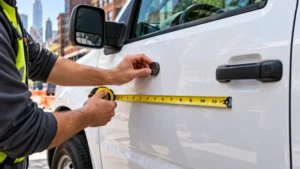
Here’s the five-minute test we suggest before anyone orders. Take an ordinary fridge magnet and touch it to each corner and the center of the area where the sign will go. Then lay a tape measure across the flattest part of the door, both width and height, and note any creases or handles. Send that photo with your order and we’ll size the sign to the flat area, not the whole door. If your vehicle is aluminum, skip magnets and look at vinyl lettering or a partial wrap instead.
Size, thickness and layout for NYC streets
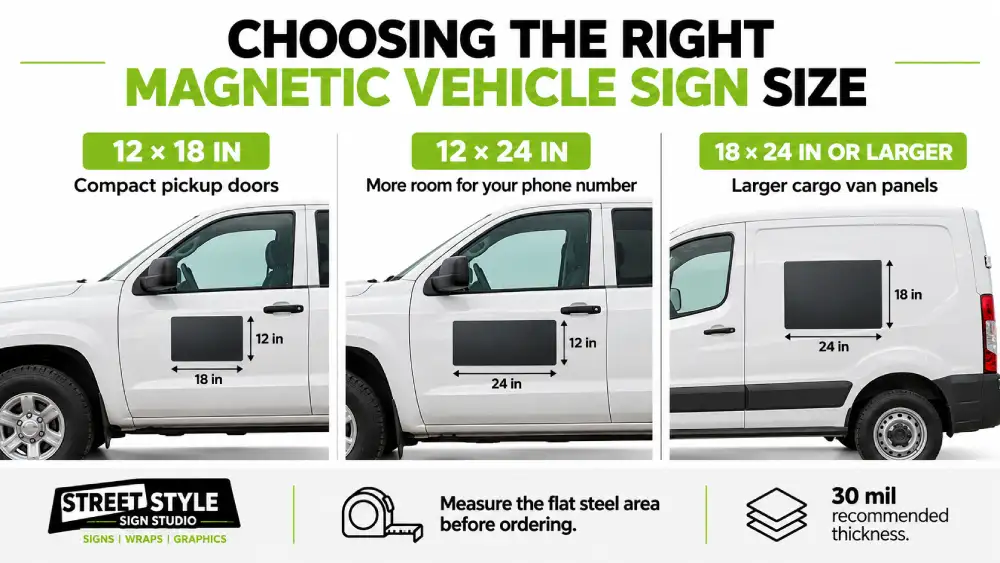
Most contractor door magnets land somewhere between 12 x 18 inches and 18 x 24 inches. Pickup and SUV doors usually take 12 x 18 or 12 x 24. Cargo van side panels have more flat area and can carry 18 x 24 or larger, which is where you can fit a bigger phone number. Order them as matched pairs for both sides, and consider a smaller magnet for a steel rear door if people follow you in traffic.
Thickness matters more than most buyers expect. 30 mil (0.030 inches) is the common standard for vehicle magnets. Thinner sheeting is fine for a fridge, but on a van doing 50 on the BQE it’s more likely to curl at the edges and lift. Rounded corners help too: a square corner gives wind something to catch.
For layout, high contrast wins. Dark lettering on a white magnet, or white on a dark one, reads better than mid-tone colors that look nice on screen. Keep the type bold and simple, give the phone number its own line, and leave a margin around the edges so nothing important sits where the magnet might lift.
Keeping magnetic signs on the truck and off the paint
Magnets don’t damage paint on their own. Trapped dirt and moisture do. NYC is hard on them in specific ways: road salt and grit through the winter, summer heat on dark vans parked in the sun all day, highway speeds on the FDR and the Belt, and street parking where an unattended sign can walk away overnight.
A routine that works for most contractors:
- Take them off at least once a week and wipe both the back of the magnet and the door with mild soap and water. Do it more often after snow, rain or a salted-road week.
- Let both surfaces dry completely before you put the sign back on. Moisture trapped under a magnet is what dulls or marks the finish.
- Apply from one edge and smooth it flat so there are no air pockets. Check that no edge crosses a body line.
- Pull them before a car wash and before overnight street parking. A sign left on the curb side overnight is an easy grab.
- Store them flat, face up, somewhere they won’t get bent or have tools stacked on them. Folding a magnet behind the seat ruins it.
- Shift the position slightly every so often if the sign stays on for long stretches, so the paint underneath and around it weathers evenly.
Treat them like a tool you maintain, not a sticker you forget about. Kept clean and stored flat, a quality pair will outlast the phone number you print on it.
Magnetic signs vs. vinyl lettering vs. vehicle wraps
| Magnetic signs | Vinyl lettering | Full or partial wrap | |
| Upfront cost | Lowest | Low to moderate | Highest |
| Removable | Yes, in seconds | Removable by a pro | Removable by a pro |
| Counts as “permanently affixed” for NYC commercial parking (current rule) | Unlikely | Yes, if 3 in. tall on both sides | Yes, if the name meets the size rules |
| Works on aluminum panels | No | Yes | Yes |
| Best for | Mixed-use, leased and overflow vehicles | Required name and license info, budget branding | Full-time work vehicles and fleets |
A lot of NYC contractors end up using two of the three. Permanent vinyl lettering carries the legal name and license numbers, and magnets carry the seasonal offer or the second trade. When the business grows into a dedicated fleet, a van wrap or truck wrap turns every vehicle into the same billboard. If you’re weighing that step, our guide to getting more from vehicle decals and vinyl lettering covers placement in more detail.
Frequently asked questions about magnetic vehicle signs in NYC
Are magnetic signs legal on vehicles in NYC?
Yes. Nothing stops you from advertising your business with a magnetic sign on your own vehicle. The issue is narrower: if the vehicle has commercial plates and you want commercial parking privileges, the current Traffic Rules call for the registrant’s name to be permanently affixed, and a removable magnet is a poor fit for that requirement.
Do magnetic signs damage car paint?
Not when they’re used correctly. Damage comes from dirt, grit and moisture trapped between the magnet and the door, or from leaving the sign in one spot for months. Remove and clean both surfaces at least weekly, dry them before reapplying, and the paint underneath stays fine.
Can I use a magnetic sign on a commercial-plated van in NYC?
You can, but don’t rely on it for the name-marking rule. Put the registrant’s name in permanent vinyl at least three inches tall on both sides, then add magnets for marketing. A proposed NYC DOT rule would align the marking with the federal standard, which allows removable devices, but it was still a proposal as of October 2026.
What size magnetic sign do I need for a truck door?
Most pickup doors take a 12 x 18 or 12 x 24 inch magnet, and cargo vans can usually fit 18 x 24 inches or larger. The right size is set by the flat steel area on your door, so measure it and avoid body lines and handles before you order.
Do magnetic signs fly off on the highway?
Good ones stay put when they’re the right thickness and sit flat. Use 30 mil magnets with rounded corners, apply them to a clean, dry panel with no body lines underneath, and check the edges before a highway trip. Thin sheeting and edges that cross a crease are what usually let go.
Do I need my license number on my truck sign?
If you hold an NYC DCWP Home Improvement Contractor license, DCWP requires the license number in your advertising, and a sign promoting your services on your vehicle counts. Interstate commercial vehicles subject to federal rules also need the carrier name and USDOT number on both sides.
Getting magnetic signs made in NYC
If you’re running jobs across the five boroughs and want something on the door this week, start with a photo of each side of the vehicle with a tape measure across the flattest part. That tells us whether a magnet will hold, what size fits, and whether part of the job should be permanent lettering for parking. Our shop on East 24th Street in Manhattan designs and prints custom magnetic signs in NYC for contractors, landscapers, cleaners, movers and other service businesses.
Not ready to order? Browse our vehicle wraps in NYC to see what a full fleet setup looks like, or send us your vehicle photos and we’ll tell you which option fits how you actually use the truck.