

A trade show floor gives every exhibitor the same handful of seconds to make a case before someone walks past. The right trade show displays and booth graphics decide whether that person stops or keeps walking, and in a market as dense with events as New York, from Javits Center’s biggest industry shows down to smaller conference expos in Midtown hotels, exhibitors are competing against dozens of other booths making the same pitch on the same aisle. This guide covers the display formats worth knowing, how booth size narrows the choice, and the NYC-specific logistics that catch first-time exhibitors off guard.
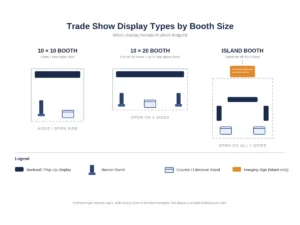
Quick answer: a 10×10 booth typically needs one backwall display plus a counter or banner stand. A 10×20 or larger footprint can support a full tension fabric wall, multiple graphics, and hanging signage if the venue’s rigging rules allow it. Match the display format to the booth size first, then the graphic design to the venue’s ceiling height and aisle traffic pattern.
Trade Show Display Types and What They’re For
Most booth setups combine two or three display types rather than relying on one. Knowing what each format is built for keeps a first-time exhibitor from either underspending on a booth that disappears into the aisle or overspending on elements the booth size can’t support.
Backwall and Pop-Up Displays
The backwall is the anchor of most booths: a large graphic panel behind the exhibitor that’s visible from down the aisle before an attendee ever reaches the booth itself. Pop-up displays use a collapsible frame with graphic panels that click into place, setting up in minutes without tools. They’re the standard choice for 10×10 booths where a full custom build isn’t in the budget or the timeline.
Tension Fabric Displays
Tension fabric displays stretch a printed fabric skin over an aluminum frame, producing a large, seamless graphic without the visible panel lines a pop-up display has. They pack down smaller than a comparable hard-panel backwall, which matters when a booth needs to travel between shows, and the fabric can be swapped separately from the frame if the graphic needs updating between events without replacing the whole structure.
Retractable Banner Stands
Retractable stands round out a backwall with a portable, single-piece unit that fits inside a rolling case, ideal for adding a second graphic point at the booth’s edge or as the entire display for a very small footprint. Because NYC convention logistics (Javits Center portability, setup windows, and the cost tradeoffs between stand grades) are covered in full in our dedicated guide, we won’t repeat that detail here. Our retractable banners page has the current sizing and hardware options if a stand is the right fit for your booth.
Hanging Signs and Truss Graphics
Once a booth reaches island size (typically 20×20 or larger, open on all sides), hanging signs suspended from the venue’s rigging points become an option and often the single most valuable graphic in the booth, since it’s visible from across the hall rather than just down one aisle. Hanging signage is subject to each venue’s specific rigging rules and often requires union labor for install at large NYC facilities, so it needs to be planned and approved well ahead of move-in rather than decided on-site.
Tabletop Displays and Literature Stands
For a booth that’s supplementing a backwall rather than building a full presence, tabletop displays and literature stands round out the setup at a lower cost and smaller footprint. Tabletop retractable banners (roughly 33 inches wide) work well perched on a counter, and a branded literature stand keeps handouts organized without cluttering the table surface, which matters more than it sounds once a booth has been open for a few hours.
Step-and-Repeat Backdrops
Some exhibitors add a step-and-repeat backdrop near their booth specifically to generate photo opportunities and social shares, a different function from the main backwall display. That format has its own design considerations around repeated logo spacing and flash photography, covered in our step-and-repeat banners guide if a photo backdrop is part of the plan.
Trade Show Display Types by Booth Size
| Booth Size | Typical Display Combination | Notes |
|---|---|---|
| 10 × 10 (inline) | One backwall (pop-up or tension fabric) + counter or banner stand | Most common convention footprint; keep the backwall as the single visual anchor |
| 10 × 20 (inline, corner) | Larger backwall + banner stand(s) + literature stand | Corner booths get two open sides; design the graphic to read from both approaches |
| 20 × 20 island | Full tension fabric walls + hanging sign + multiple counters | Open on all sides; hanging sign becomes the primary long-distance visual |
| 20× 40+ island | Custom modular build + hanging sign + multiple graphic zones | Requires early venue rigging approval and typically union labor for install |
Designing Graphics That Read from the Aisle
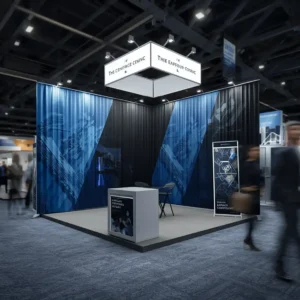
A backwall graphic gets read from two very different distances: 20 to 40 feet, when an attendee is scanning the aisle deciding where to stop, and 3 to 5 feet, once they’re standing at the booth. Design for both. The headline and logo need to register at the aisle distance, which means large type and high contrast, while supporting details, product specs, contact information, can be smaller since they’re only read up close.
Keep the primary message to a handful of words. A backwall crowded with paragraphs of copy loses the one job it actually has, which is making an attendee curious enough to stop and ask a question. The booth staff exist to deliver the detailed pitch; the graphic’s only job is to earn the conversation.
NYC Convention Logistics to Plan Around
Booth graphics that look right in a design file can still run into venue-specific rules that catch exhibitors off guard on move-in day. Planning around these ahead of time avoids a scramble at the loading dock.
Drayage and Material Handling
Large NYC venues like the Javits Center use general service contractors who handle moving crated displays from the loading dock to the booth space, a service billed separately as drayage and priced by weight. Lighter, more compact display formats (tension fabric over a hard-panel build, for instance) can meaningfully reduce this cost across a full show schedule, which is worth factoring into the display-type decision, not just the sticker price of the display itself.
Move-In and Move-Out Windows
Convention centers assign specific move-in and move-out windows, often just a few hours, and displays that need on-site assembly (custom builds, rigged hanging signs) need to be scheduled and, at larger venues, staffed with union labor within that window. Pop-up and tension fabric displays that set up without tools are the more forgiving choice when the move-in schedule is tight or unpredictable.
Storage Between Shows
Exhibitors who show multiple times a year should factor in how a display stores between events. A collapsible pop-up or tension fabric display fits in a closet or small storage unit; a large custom modular build often needs pallet storage and a shipping plan between each show, which adds ongoing cost that’s easy to underestimate when only pricing out the initial build.
Choosing the Right Display for Your Next Show
Start with booth size, since it eliminates options before budget even enters the conversation. From there, weigh how often the display travels (favoring lighter, collapsible formats) against how much visual presence the show demands (favoring larger tension fabric walls and hanging signage for bigger footprints). Our trade show displays team scopes NYC exhibitors through this exact decision regularly and can walk through venue-specific requirements for your next show before you commit to a format.
Questions About Trade Show Displays and Booth Graphics
What display do I need for a 10×10 trade show booth?
A 10×10 booth typically works best with a single backwall display, either a pop-up or tension fabric format, paired with a counter or a retractable banner stand. That combination anchors the space without crowding the footprint.
What’s the difference between a pop-up display and a tension fabric display?
A pop-up display uses a collapsible frame with rigid graphic panels that click into place. A tension fabric display stretches a printed fabric skin over a frame, producing a seamless graphic that packs down smaller and allows the fabric to be replaced separately from the frame.
Do I need special permission for hanging signs at a NYC convention?
Yes, in most cases. Hanging signage is subject to each venue’s rigging rules, and large NYC facilities typically require union labor for installation. It needs to be approved and scheduled well before move-in, not decided on-site.
What is drayage and why does it matter for booth displays?
Drayage is the service that moves crated displays from the loading dock to your booth space, billed separately and priced by weight. Lighter display formats can reduce this cost meaningfully across a full show schedule.
How far in advance should I order trade show booth graphics?
For a standard backwall or banner stand, two to three weeks before the show is typically enough. Custom modular builds or anything requiring venue rigging approval should be planned at least six to eight weeks out to account for design, production, and venue paperwork.
Can the same display be reused across multiple shows?
Yes, most formats are built for repeat use. Pop-up and tension fabric displays are the easiest to store and transport between shows; custom modular builds require more planning for storage and shipping but also offer the most flexibility to reconfigure for different booth sizes.