
If you manage a medical or dental office in New York City, HIPAA compliance probably sits somewhere on your operations checklist between staff training and EHR access controls. What often doesn’t make the list, but should, is the physical privacy of your treatment rooms, reception windows, and consultation areas. Specifically, whether anyone standing in your waiting room, hallway, or street-level window can see a patient’s chart, a monitor, or an interaction they shouldn’t.
Window privacy film NYC solutions address exactly this gap. Applied to interior glass partitions, treatment room doors, or exterior-facing windows, frosted and printed film blocks sightlines without requiring construction, making them a practical solution for healthcare offices throughout New York City.
This post covers how window privacy film connects to HIPAA physical safeguard requirements, which film types work best for different areas of a medical or dental office, what the NYC-specific installation process looks like, and what the investment typically runs for Manhattan practices.
How HIPAA Physical Safeguards Apply to Window Glass
The HIPAA Security Rule, codified at 45 CFR 164.310, requires covered entities to implement physical safeguards for workstations and facilities where electronic protected health information (ePHI) is stored or accessed. Two standards within this section are directly relevant to glass and sightlines.
The workstation use standard (45 CFR 164.310(b)) requires covered entities to implement policies that govern the use of workstations that access ePHI, including physical surroundings. If a front desk computer screen displaying patient records is visible from the waiting room through a glass partition, that represents an unaddressed physical safeguard gap.
The facility access controls standard (45 CFR 164.310(a)(1)) requires procedures to limit physical access to systems that house ePHI, allowing only authorized personnel. A treatment room with a glass door or sidelight visible from a shared hallway can expose patient interactions and records to anyone passing by.
Window privacy film directly addresses both standards by blocking sightlines. It does not replace a comprehensive HIPAA security plan, but it closes a specific physical vulnerability that many NYC medical and dental offices leave open, often because the alternatives (frosted glass replacement, permanent partitions) feel more disruptive than the risk warrants.
One practical note: HIPAA does not prescribe specific materials or methods. It requires that covered entities implement reasonable and appropriate physical safeguards. Window film is a documented, removable, cost-effective implementation that practices can reference in their risk assessment documentation.
Which Areas of a Medical Office Need Privacy Film
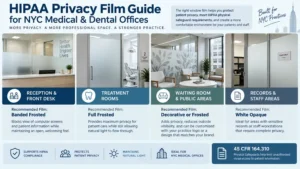
Not every surface in a medical office needs film. The areas that matter most are those where patient information, faces, or interactions are visible to people who have no clinical or administrative reason to see them.
Reception and Front Desk Windows
The front desk is the most common privacy problem in medical offices. If reception staff sit behind a full glass window or an open counter with a monitor facing the waiting room, patient data on screen and patient check-in conversations are exposed. A banded frosted film covering the lower portion of the glass (typically from counter height upward 24 to 36 inches) blocks sightlines to screens while keeping the upper window clear for face-to-face communication.
Treatment Room Doors and Sidelights
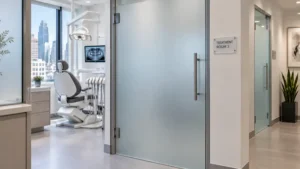
Treatment room doors with glass panels or sidelights let anyone in a hallway see the patient inside. This is common in dental offices, dermatology practices, and physical therapy clinics where rooms are arranged along a corridor. Full frosted film on the glass panel of the door, or a band across the sidelight, eliminates the sightline while preserving the light and the visual openness of the space.
Interior Glass Partitions
Modern office buildouts in Manhattan often use glass partitions to create the open feel landlords and tenants both prefer. For medical offices, those partitions create privacy problems between clinical and administrative areas. Frosted or decorative printed film on the glass maintains the architectural intention while creating the visual separation HIPAA requires.
Street-Facing Windows
Ground-floor medical offices on Midtown or downtown Manhattan streets often have large storefront windows. If the waiting room or reception area is visible from the sidewalk, names on clipboards, monitor screens, and patient faces are all exposed. Frosted film on the lower half of the window, or a full frosted treatment from the sill to approximately five feet, addresses this without blocking natural light entirely.
Film Types and Their Applications
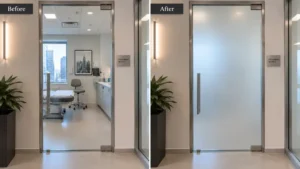
The right film type depends on how much light you want to preserve, whether you need branding on the glass, and the specific privacy function required.
| Film Type | Light Transmission | Privacy Level | Best For |
| Frosted / etched-effect | High (diffused) | Full obstruction | Treatment room doors, interior partitions |
| Banded frosted | High above the band | Partial (lower field) | Reception windows, front desk glass |
| White opaque | None | Full obstruction | Server rooms, records storage areas |
| Printed decorative | Varies by design | Varies by coverage | Waiting rooms, branded reception glass |
| One-way / solar | Moderate (tinted) | Outward-only from exterior | Street-facing windows in direct sun |
In our experience with NYC medical and dental clients, frosted window film NYC installations -whether full or banded- cover the majority of privacy needs in a typical practice. Printed decorative film with the practice logo or a geometric pattern is increasingly common in waiting rooms where owners want the space to feel designed, not just compliant.
Example: A three-room dental practice in Midtown Manhattan replaced clear treatment room door glass with frosted film and added a branded reception privacy band. The installation was completed in one evening, allowing the office to reopen the next morning without interrupting patient appointments.
NYC-Specific Considerations
Permits
Window film applied to interior glass surfaces in a NYC commercial space does not require a NYC Department of Buildings permit. Film on exterior-facing glass is generally also permit-free, but there are exceptions. Buildings in NYC landmark districts, buildings with specific lease restrictions on window treatments, and buildings with exterior design standards (common in Class A commercial towers) may require landlord approval or building management sign-off before installation. Your sign company should confirm this before the job starts.
Lease Considerations
Most NYC commercial leases include an alterations clause that requires landlord approval for modifications to the premises. Window film typically falls below the threshold that triggers a formal alteration approval, but the definition varies by lease. The relevant advantage of film is that it is removable: professional-grade film releases cleanly from commercial glass after three to five years of normal use, leaving the premises in original condition as most leases require.
NYC DOH Inspections
New York City Department of Health inspections of medical offices don’t specifically audit window privacy, but investigators do note conditions that could affect patient confidentiality. In practice, an office that has clearly addressed physical privacy through film, partitions, or other measures is better positioned during an inspection than one that has open sightlines to clinical areas. This is a secondary benefit that’s worth documenting in your facility’s HIPAA risk assessment.
How Much Does Window Privacy Film Cost for Your NYC Office?
Every medical and dental office is different. The cost of window privacy film depends on the number of surfaces, the square footage involved, the film type selected for each area, and whether the glass has any special coatings that require upgraded adhesive products. Rather than publish ranges that may not reflect your specific situation, we prefer to assess the space and give you an accurate number.
Contact us for a free site assessment and quote. We work with practice managers and office administrators across Manhattan and the five boroughs, and we can usually turn around a quote within one business day.
Can Custom Branding and Privacy Coexist?
Yes, and it’s increasingly the standard for well-designed medical and dental offices in Manhattan. A printed window film carrying the practice name, logo, or a design pattern can cover the same glass surface that needs to be opaque for HIPAA reasons. The privacy function and the branding function are not in conflict.
A common approach: frosted film with the practice logo cut out in clear vinyl on the treatment room door, so the logo reads as a clear window against a frosted background. Another: a geometric pattern in the practice’s brand colors across the reception partition, providing full opacity with a designed look rather than plain frosted white.
From a patient experience standpoint, a waiting room where the glass feels intentional, rather than frosted as an afterthought, reads as a more considered practice. In competitive specialties like cosmetic dentistry or dermatology, that perception is worth investing in.
What Else NYC Medical Offices Need
Window film addresses visual privacy for patient interactions and data. It works alongside the broader signage system that keeps a medical or dental office functional and compliant. Healthcare signage for NYC medical offices covers the room identification signs, ADA and Braille signs for accessible bathrooms and treatment areas, and directional wayfinding signs that patients and staff both depend on.
Addressing privacy film and room signage together, from the same vendor, keeps the visual system coherent and simplifies coordination with building management. It also means the ADA compliance review and the HIPAA risk assessment can reference the same installation record.
HIPAA Window Privacy Film FAQs for NYC Medical & Dental Offices
Is window film HIPAA compliant?
Window privacy film can be part of a HIPAA-compliant physical safeguard plan. The HIPAA Security Rule (45 CFR 164.310) requires covered entities to implement physical measures that limit unauthorized access to areas where ePHI is stored or accessed and prevent unauthorized visual access to patient data and interactions. Frosted, opaque, or printed window film applied to glass partitions, treatment room windows, and reception windows directly addresses this requirement by blocking sightlines to screens, charts, and patient interactions. It does not replace other HIPAA safeguards, but it closes a specific and common physical gap.
What type of window film is best for a medical office?
Frosted or etched-effect film works well for treatment room partitions and doors because it admits light while blocking direct sightlines. For reception windows where staff need to see and speak with patients, banded frosted film covering the lower portion of the glass is more practical. For waiting rooms with street-facing windows, full frosted or decorative printed film provides privacy without requiring structural changes.
Does window film require a permit in NYC for medical offices?
Window film applied to interior glass generally does not require a NYC DOB permit. Film on exterior-facing windows in landmark districts or buildings with specific design standards may require landlord approval before installation. A sign company experienced with NYC commercial installations will confirm the building’s status before starting work. Skipping this check is not a compliance risk, but it can create friction with building management after the fact.
Can window film be removed or replaced?
Yes. Professional-grade window privacy film is designed to be removable without damaging the glass. This matters for NYC medical offices in leased space, since most commercial leases require the premises to be returned to original condition at lease end. Quality film applied by a professional installer releases cleanly from standard commercial glass after three to five years of normal use. Ask your installer about the removal process before committing to a product.
How much does window privacy film cost for a NYC medical office?
Window privacy film for NYC medical and dental offices typically runs $8 to $20 per square foot installed, depending on film type and the number of surfaces. A standard three-room dental office in Manhattan with film on treatment room doors and a reception partition usually costs $1,200 to $2,800 total. Custom-printed decorative film with practice branding costs more than plain frosted film. These figures include professional installation; DIY film application is generally not recommended for clinical environments where a clean, seamless result matters for both compliance and appearance.
If you’re updating your office for privacy, it’s often more efficient to coordinate window film with custom signs for NYC medical offices so branding, ADA compliance, and patient wayfinding are handled as one cohesive project.