

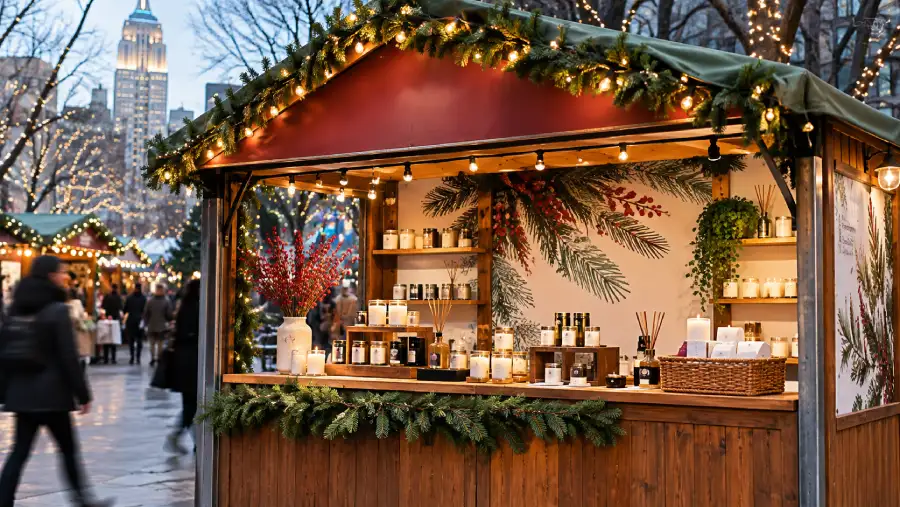
A holiday market kiosk in New York gives you about ten feet of frontage and a few seconds of a passing shopper’s attention. This year the Union Square Holiday Market opens November 12, Columbus Circle follows on December 1, and the market at Herald Square arrives December 3 (Urbanspace announcement via BroadwayWorld). If you have a stall booked, your signs need to be designed, approved and printed in the next few weeks.
Holiday market booth signs in NYC come down to four pieces: a header sign with your name that reads from down the path, a printed back wall that shows what you sell, price or menu boards at eye level, and lighting that keeps all of it readable after dark. Size each piece to the kiosk you were actually assigned, not to a generic 10×10 tent, and get the market operator’s sign-off before anything goes to print.
Key takeaways
- Measure the stall you were assigned. Union Square and Columbus Circle kiosks run about 9’10” wide, 5’10” deep and 7’10” tall.
- The header sign does most of the selling from the path: big letters, strong contrast, one name.
- Fabric prints are the easiest way to cover the back wall, and they photograph without glare.
- It’s dark by about 4:28 p.m. in early December, so plan lighting together with the signs.
- Ask the operator what needs approval. Signage that breaks the market’s guidelines can cost you a fine.
What signs does a holiday market booth need?
Most first-time vendors order one banner and stop there. A kiosk works better when each surface has one job, and the list is short:
- Header or fascia sign: your business name on the strip above the opening. This is how people find you again.
- Back wall graphic: a fabric print or panel behind the counter that shows your product or your story.
- Side panels: worth it on corner stalls, where shoppers come at you from two directions.
- Price and menu boards: at eye level, near the counter, easy to update.
- Counter signs: payment methods, a QR code to your online shop, gift-wrap or shipping offers.
- Lighting for the signs: the market is dark from late afternoon, and an unlit header is close to invisible.
You won’t need all six on opening day. A half booth may only have room for a header, one back panel and a price board. Still, think through every surface before you order, because the pieces share a small space and should look like they came from the same brand, not three different print shops.
Design for the kiosk you’ll actually get

Most booth advice online assumes a 10×10 pop-up tent at a craft fair. The big Manhattan holiday markets don’t work like that. At Union Square and Columbus Circle, Urbanspace rents fixed kiosks that measure roughly 9’10” wide, 5’10” deep and 7’10” tall, and half booths are about half the width at the same depth and height (Urbanspace vendor FAQ).
That shallow depth changes the design. Shoppers stand right at your counter, so the back wall sits maybe six feet from their eyes, while the header has to reach people 30 or 40 feet down the path. One artwork file scaled up or down won’t serve both distances. The header needs fewer, bigger words; the back wall can carry a photo and a little detail.
Before you design anything, get three things from the operator:
- Your exact stall assignment, and whether it’s a full, half or combined booth.
- The dimensions of the header area and any other surface you’re allowed to cover.
- The rules on what can be attached to the kiosk, and how.
That last one matters more than vendors expect. Urbanspace’s vendor application has said that fines apply to signage or displays that don’t conform with its guidelines, and to damage to the kiosk (Union Square application). Adhesives, screws and staples you’d use without a second thought in your own shop may not be allowed on a rented structure. Ask first, then pick materials that fit the answer: banners that tie on through grommets, fabric that hangs from hook-and-loop or a tension rod, or rigid panels on a freestanding frame inside the booth.
When clients bring us a market job, the most useful thing they can send is the operator’s spec sheet or a photo of the kiosk with a tape measure in the shot. We’d much rather size from that than from a guess.
Make the header sign readable from down the path
The header is the one sign that has to work at a distance. A common rule of thumb for event and market signs is about one inch of letter height for every ten feet of viewing distance, so 4-inch letters read at roughly 40 feet (Homegrown’s market signage guide). Treat that as the floor, not the target. On a holiday path people are walking, it’s often getting dark, and your neighbors’ signs are competing for the same glance.
Put your business name on it and, if the name doesn’t explain itself, a few words about what you sell. “Marta’s” tells a shopper nothing. “Marta’s Hand-Poured Candles” gives them a reason to slow down. Leave the website, Instagram handle and tagline off the header; every extra line shrinks the name. Those details belong on a counter sign, where people are close enough to read them.
Use a plain, heavy typeface and high contrast. Script fonts look lovely on a proof and turn into a smudge at 30 feet, especially under warm string lights. If the market has a color scheme for kiosk headers, ask whether yours has to fit inside it before you approve a design.
Fabric prints for the back wall and side panels

The back wall is where a shopper decides whether your booth is worth stepping up to, and for that surface we usually recommend fabric. Dye-sublimation is a printing method that bonds ink into polyester fibers instead of laying it on top, so the print won’t crack when folded and the matte surface doesn’t throw back glare.
The glare point gets underrated. People photograph market booths all day, and a glossy back wall under string lights looks washed out in every phone picture that ends up on Instagram. A matte fabric wall looks the same in the photo as it does in person.
Fabric also suits the way a market season actually runs. It hangs from a pole pocket, grommets or hook-and-loop, comes down without tools, and folds into a bag if you take it home at night or want to reuse it at a spring market. For a cleaner finish, a silicone edge graphic (SEG) frame holds the print tight inside an aluminum frame that stands on its own, so nothing has to be fastened to the kiosk at all. Our custom fabric prints are made for exactly this kind of setup, with the hems, pockets or SEG edges your mounting calls for.
What to put on the back wall: one strong image of your best product, or a simple pattern in your brand colors with your logo. Keep prices off it. They change, and they’re too far from where the buying decision happens.
Signs that still work at 4:28 p.m.
New York’s earliest sunset of the year comes in early December, at about 4:28 p.m. (NY1). Markets stay open for hours after that, so a large share of your selling happens under artificial light. Plan the signs and the lighting as one job.
Urbanspace says each Union Square booth comes with six 120-volt Edison plugs, with more power available on request (Urbanspace vendor FAQ). That’s plenty for practical options:
- LED strips or small clip-on spots aimed at the header.
- A backlit fabric lightbox as the back-wall centerpiece. Backlit fabric is made to spread light evenly, which is what you want behind a logo.
- Warm string lights around the opening, kept clear of the lettering so they don’t cut through your name.
Interior lighting and fixtures at Union Square are subject to Urbanspace approval, so check your plan with the operator before you buy anything.
Two quick checks before you sign off on a proof. First, look at the header artwork on your phone at low brightness; it’s a rough stand-in for dusk. Second, avoid dark-on-dark pairings like navy on forest green, which look rich on screen and vanish once the light goes.
Built for six weeks outdoors
A one-day street fair asks very little of a sign. A holiday market asks it to get through weeks of wind, rain, snow, condensation and daily handling: Union Square alone runs November 12 to December 24 this year. Anything that faces outside should be made for that.
- For the header and other exterior surfaces, outdoor-grade vinyl banners with hemmed edges and reinforced grommets hold up far better than paper or foam board, which warps on the first damp day.
- Wind gets under anything fastened only at the top. Secure every corner, or switch to a rigid panel.
- If you plan to put vinyl decals on kiosk glass, ask about timing. Cold surfaces weaken adhesive bonds, so a decal applied on a freezing morning can start lifting by the weekend.
- Print a spare set of price boards and counter signs. Something will get wet, bent or walk off.
For a closer look at how vinyl wears outside over time, see our post on how long vinyl banners last outdoors in NYC.
Price boards and menus you can change mid-season
Prices move during a market. You sell out of a size, add a bundle for the final week before Christmas, or drop a flavor that isn’t selling. Your price signs should be the cheapest and easiest thing in the booth to replace.
Keep the frame permanent and the content swappable: a rigid board with printed inserts, a menu panel with replaceable strips, or a printed card in a clear holder for each product group. Grouping by price (“All ornaments $18”) reads faster than tagging every item separately.
Food vendors have a harder job, because the menu has to work for someone standing in line. Keep it short enough to read from the back of the line, put each price right next to its item, and place allergen notes where people see them before they order, not after.
Finish with a small counter sign for payment methods and a QR code. Point the code somewhere useful, like your online shop or a gift-card page, so a shopper who doesn’t buy today can still find you in January.
Market kiosk vs. street fair tent vs. trade show booth
A lot of booth advice blurs these together. A street fair is usually a single day under a pop-up tent, where light banners and fast setup matter most; we covered that in outdoor banners for NYC street fairs and block parties. A trade show booth is indoors, under even lighting, with the venue’s rules and contractors; see trade show displays and booth graphics for NYC conventions.
A holiday market kiosk sits between the two. It’s a fixed structure you rent for weeks, it’s outdoors, an operator approves what goes on it, and much of your selling happens after dark. That combination is why signs bought for a craft fair often look tired by the second week of December.
When to order your holiday market signs
Work backward from opening day. Here are this year’s dates for three of Urbanspace’s Manhattan markets, from the operator’s announcement (BroadwayWorld):
| Market | 2026 dates |
|---|---|
| Union Square Holiday Market | November 12 to December 24 |
| Columbus Circle Holiday Market | December 1 to December 31 |
| Herald Holiday Market (Herald and Greeley Squares) | Market opens December 3; most attractions open November 12 |
For each one, leave room for the steps that usually slow things down: getting your stall assignment and dimensions, getting artwork approved by the operator, proofing with your printer, production, and a test hang before opening day. In our experience, approvals take longer than printing, so send artwork for approval as early as you can.
If you’re opening at Union Square, that window is already tight. Tell us your opening date when you ask for a quote and we’ll tell you plainly what’s realistic and what isn’t.
FAQ
What size should a holiday market booth sign be?
Size it to your kiosk rather than to a standard banner size. For a Union Square or Columbus Circle stall roughly 9’10” wide, a header that spans most of the width works well, with letters at least four inches tall so they read at about 40 feet. Confirm the exact header area with the market operator before you print.
What should a vendor booth sign say?
Your business name and a few words about what you sell. Social handles, websites and prices belong on smaller signs at the counter, where people are close enough to read them.
How do I make my holiday market booth stand out?
Give each surface one clear job: a readable header, a strong back-wall image and prices that are easy to find. Then light it, since much of the selling happens after dark. A booth a shopper understands in a few seconds usually beats one packed with more decorations.
How do you light a vendor booth at an outdoor holiday market?
Use the power the booth comes with, such as the six 120-volt outlets standard at Union Square, for LED strips, small spotlights on the header or a backlit fabric panel. Check the operator’s rules first, because lighting and fixtures usually need approval.
Are fabric or vinyl banners better for a market kiosk?
Each has its place. Fabric is better for back walls and anything shoppers photograph, because it’s matte and folds without creasing. Outdoor vinyl with reinforced grommets is better for surfaces exposed to wind and wet weather.
How far ahead should I order holiday market signs?
As soon as you have your stall assignment. Operator approval and proofing usually take longer than printing, so starting several weeks before opening day gives you room to fix anything that comes back.
Get a booth that reads from the path
Street Style Sign Studio prints fabric backdrops, banners and counter signs at our shop on East 24th Street in Manhattan, and we can size a full kiosk package from your operator’s spec sheet. Send us your booth dimensions and opening date and we’ll suggest what fits your stall and your timeline. If you also run a permanent storefront, take a look at our window graphics for the season.