

Get Professional Signage That Boosts Your Business Visibility, Fast & Hassle-Free!
New York City Directory Signs
Your building’s directory is the first point of interaction for every visitor. It’s the critical link between the front door and the right office. A confusing, outdated, or unprofessional directory creates frustration and reflects poorly on the entire building. The same is true on a campus, where our school signs help students, parents, and visitors find the main office, classrooms, and exits without asking for directions.
Street Style Sign Studio designs, fabricates, and installs custom directory signage that works hand in hand with the rest of your interior signage to guide every visitor with confidence. We create clean, easy-to-read, and easy-to-update systems that enhance your lobby, complement your custom lobby signage, and simplify tenant management for years to come.
We are the partner of choice for property managers, building owners, and business complexes across Manhattan, Brooklyn, Queens, Long Island, and Jersey City.
Why It Matters
A building directory is a high-stakes sign.
It has to look professional, be 100% accurate, and be simple to modify. A good system streamlines traffic and elevates your property; a bad one is a constant headache.
A sleek, modern directory that matches your lobby’s architecture makes a powerful statement. It tells visitors and tenants that this is a professional, well-managed property.
A clear, legible directory is the ultimate customer service tool. It empowers visitors to find their destination confidently and quickly without interrupting your staff.
Tenants change. Your directory must be able to change with them. We design our directory signage systems to be easily and affordably updated, without tape, crossed-out names, or messy DIY solutions.
What We Build
We offer a range of solutions, from timeless modular systems to modern digital displays, all customized to your property.

01 · The Industry Standard
Interchangeable strips are the industry standard for a reason. These systems feature metal or acrylic slats that slide in and out, enabling you to easily and cost-effectively update a single tenant’s name.

02 · Architectural & Clean
A clean, architectural solution. We create custom-fabricated plaques in materials like glass, acrylic, or metal, with tenant names professionally printed or applied.

03 · For Frequent Changes
The ultimate solution for large buildings or properties with frequent tenant changes. An elegant LCD screen displays a searchable, easy-to-update list of tenants, floors, and contacts.

04 · Wayfinding
We also create the “mini-directories” for each floor, reinforcing navigation and guiding visitors as they exit the elevator.
At a Glance
Here is how the three core directory approaches described above compare, at a glance:
| Directory Type | Best For | Update Method | Relative Cost |
|---|---|---|---|
| Static (Custom Wall-Mounted) | Low tenant turnover, high-end architectural lobbies | Requires a new fabricated plaque or panel | Mid-range to premium, one-time cost per update |
| Modular (Interchangeable Strips) | Small to mid-size buildings with occasional tenant changes | Slide a new printed strip into an existing frame | Affordable, low cost per individual update |
| Digital (LCD Screen) | Large buildings (100+ tenants) or very frequent changes | Typed directly into software from any computer | Higher upfront investment, lowest cost per update over time |
The right choice usually comes down to how often your tenant roster actually changes, not which system looks the most modern. A building with low turnover often gets the best value from a static or modular system, while a property with frequent leasing activity recoups a digital screen’s higher upfront cost through fewer service calls over time.
A directory’s capacity depends on readable entries, not simply on how many names can fit into the frame. Prepare the tenant list before settling on dimensions. Long business names, shared suites, floor labels, and future additions can change the layout substantially.
Use one approved source for the text. Include the visitor-facing business name, floor, suite, and any short qualifier needed to distinguish similar names. Decide whether the list will be alphabetical or grouped by floor, then apply that choice consistently.
| Information | Review before approval |
|---|---|
| Tenant name | Official display wording, including punctuation |
| Destination | Floor and suite that match the room signs |
| Sorting rule | Alphabetical or floor-based order |
| Future changes | Space or update method for additions and departures |
Avoid reducing all the text to accommodate one unusually long name without reviewing the alternatives. The finished directory should remain easy to use for the building’s visitors. Coordinate it with door signs and the broader office signage plan so the same destination is described the same way throughout the journey.
Materials
A directory sign must be durable. We use only architectural-grade materials that match your building’s aesthetic and withstand daily use.
Aluminum, Stainless Steel
Frosted, Clear, or Back-Painted
Warm, architectural finishes at a lower cost
For digital directory systems
Cost & Budgeting
System type is the first cost driver on any signage building project, as the comparison above shows: modular systems are the most affordable to install and update, static wall-mounted plaques cost more upfront but rarely need service calls, and digital screens carry the highest initial investment with the lowest cost per future update.
Beyond system type, three things move the price: material (brushed metal and glass or back-painted acrylic cost more than a standard laminate), size and tenant count (a 200-tenant high-rise directory is a bigger fabrication job than a 12-tenant office floor), and installation complexity (a flush wall mount is simpler than a recessed or illuminated installation, and a digital screen adds a power run and sometimes a network connection). As one of the building signage companies that fabricates in-house, we quote all of this after seeing your lobby and tenant count, rather than pricing a directory sign as a single flat-rate product.
Our Work
Testimonials


Our Standard
We are specialists in designing systems that you can manage. We’ll recommend the perfect solution (e.g., modular strips vs. digital) based on how often your tenants change.
Your directory won’t be a “stock” product. We design it to be a seamless, integrated part of your lobby’s interior design.
We ensure your directory signage is fully compliant with all NYC and ADA codes, including proper Braille for floor numbers and accessible, high-contrast text.
Our team installs your directory with precision and care, minimizing disruption to your lobby and tenants.
Compliance
Quick Answer
Your tenant list itself is exempt from Braille and tactile character requirements because it is expected to change. Permanent signs near it, like fixed floor designations, are not exempt.
Directory signage sits in a part of the Americans with Disabilities Act that surprises a lot of property managers. Under the ADA’s 2010 Standards for Accessible Design, Section 703 (the section that governs tactile and Braille signage), building directories, occupant names, and company names or logos are specifically listed as exempt from the raised-character and Braille requirement, precisely because that information is expected to change. The U.S. Access Board, the federal agency that writes and publishes guidance on these standards, confirms this exemption directly: signs that need to be updated frequently, including directories, do not have to carry tactile characters or Braille.
That exemption is easy to misread as “directories don’t need to be accessible.” They still do, just through different requirements. Section 703 still governs the visual characteristics of any sign that is provided, including yours: high-contrast, non-glare lettering, a sans-serif or simple serif font, and consistent, legible sizing. Where your directory shares a wall with, or sits near, permanent wayfinding elements like restroom signs or floor-level identification at an elevator bank, those specific signs do fall under the full tactile and Braille requirement, since the Access Board’s guidance defines “permanent rooms and spaces” as room numbers, room names, and floor designations that are not expected to change without a significant renovation.
New York City folds these accessibility standards into its own Construction Codes, which is why compliance here is a building code question as much as a federal one, not just an ADA question in isolation. If your building is in a landmarked property or historic district, any new or replacement signage, directory included, may also need sign-off from the Landmarks Preservation Commission before installation, on top of accessibility review.
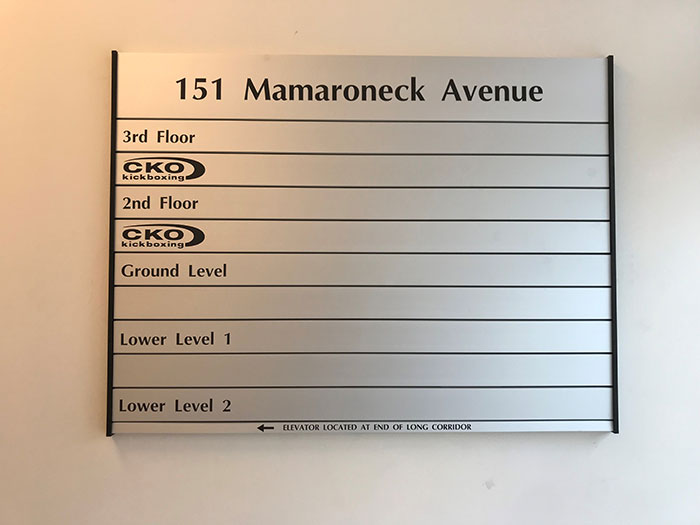
In practice, this is exactly the kind of detail our team walks through during your lobby consultation. Because directory signage is only one piece of a larger sign building project inside most commercial lobbies, from wall-mounted plaques down to the small floor signs at your elevator bank, we review every one of them for the compliance standard that actually applies to it, rather than applying a single blanket rule to all of them.
A directory answers where a destination is; the next sign should help visitors get there. Walk the route from the lobby listing to the elevator, across the destination floor, and to the final door. Look for places where a person unfamiliar with the building would have to stop and guess.
For example, a lobby entry might list a company on Floor 4, Suite 402. The floor landing needs to make the next direction understandable, and the door should use the same company name and suite number. This is an illustrative route, not a specification for a particular building.
Keep destination naming consistent even when sign formats differ. A department known internally by an acronym may need its full name for visitors. Review arrows from the viewer’s position rather than from the orientation of a floor-plan drawing.
Separate navigation decisions from any required room-identification or accessibility review. Different sign functions can carry different requirements. We can review your directory as part of the wider interior signage system, with the building team confirming the scope that applies to each location.
How It Works
We meet at your property to understand your lobby’s layout, your aesthetic, and, most importantly, your tenant update frequency.
Our team designs a directory system that meets your needs, providing a to-scale proof of concept that shows how it will look in your space.
Your directory is fabricated in-house from your chosen materials, with a focus on precision and durability.
We install your new directory perfectly. If your system is modular or digital, we provide a simple walkthrough so your staff knows exactly how to manage and update it.
A directory stays useful when someone owns the tenant information after installation. Name the person who approves changes, and keep the current roster separate from older versions. That simple handoff helps prevent an outdated spreadsheet from becoming a new printed insert.
For a physical system, retain the frame specification, insert sizes, finish, approved font, and sample layout. Record whether a single entry can be replaced independently or whether an update affects a larger panel. Ask about the replacement process before choosing a system for a building with regular tenant turnover.
If a digital directory is under consideration, define who will edit it, what access they need, and what ongoing support or software costs are included. Those details belong in the project scope; the screen alone does not explain how the directory will be maintained.
Send the tenant roster, lobby photos, approximate wall dimensions, address, and expected update frequency when requesting a quote. Include any planned lobby changes so the directory can coordinate with reception signage. A clear information handoff makes future updates more predictable and keeps the installation useful as the building changes.
Stop letting an outdated or messy directory frustrate your visitors. Street Style Sign Studio is your partner for creating a clean, professional, and easy-to-manage directory signage system. Contact our New York City team today for a consultation and quote for your building.
Everything property managers usually ask before ordering a directory system.
This is the most important question. We design the system for you. For modular signs, we provide new, professionally made name “slats” that you can easily slide into place. For digital directories, we provide simple software that lets your building manager type in a new name from a computer.
Absolutely. This is our specialty. We will design your directory using the same materials and finishes (e.g., brushed aluminum, specific wood tones, Pantone-matched colors) as your lobby for a fully integrated, high-end look.
A static directory (like a modular strip system) is a physical sign. It’s best for buildings with low-to-medium tenant turnover. A digital directory is a screen. It’s the best choice for large buildings (100+ tenants) or properties with very frequent changes, as updates can be made instantly from a computer.
Yes, in several ways. While the individual tenant names do not typically require Braille, the permanent parts of the sign (like the “Directory” header or floor numbers) often do. The sign must also be legible, high-contrast, and installed at an accessible height. We handle all compliance for you.
Cost depends mainly on system type, size, material, and installation complexity. Modular strip systems are the most affordable way to get a professional, updatable directory, static wall-mounted plaques cost more upfront but need fewer service calls, and digital screens carry the highest initial investment but the lowest cost per update over time for buildings with frequent tenant changes. We provide an itemized quote after a lobby consultation, once we know your tenant count and update frequency.