

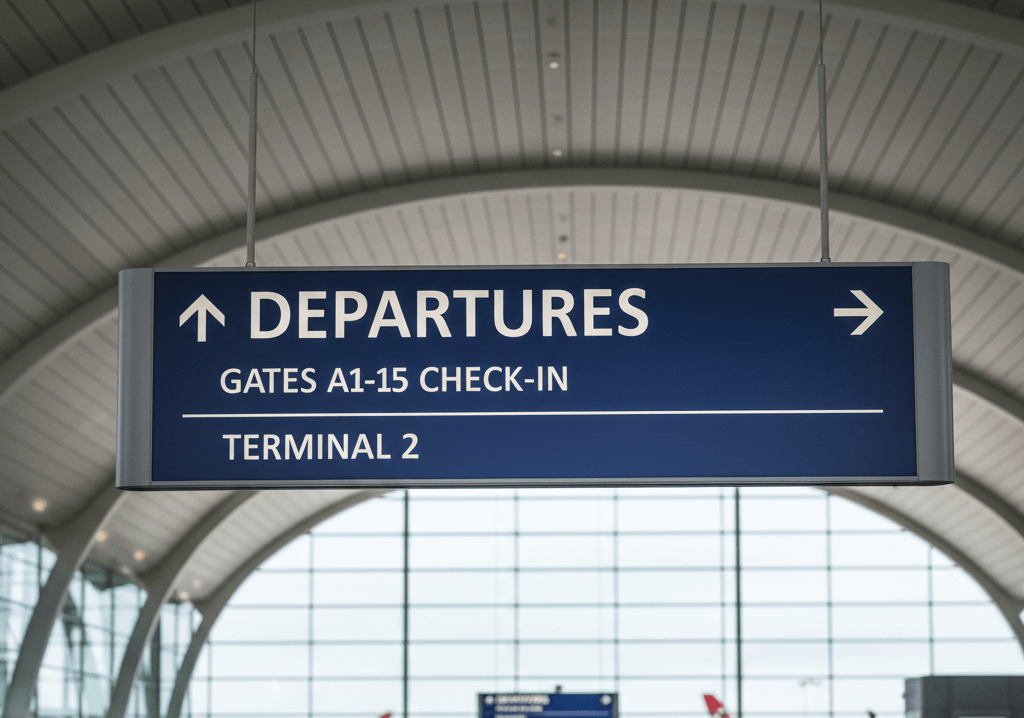
Airports are among the most complex environments for navigation, especially in a city as fast-paced and diverse as New York City. With millions of passengers moving through JFK, LaGuardia (LGA), and Newark Liberty International (EWR) every year, airport wayfinding must bridge languages, cultures, and constant schedule changes. Clear, effective signage isn’t just a convenience here; it’s a necessity.
Traditionally, airports relied on fixed, high-visibility signs that guided passengers to gates, restrooms, and exits. Today, these are joined by digital displays, such as Flight Information Display Systems (FIDS) and interactive kiosks, that deliver real-time updates.
At Street Style Sign Studio, we’ve seen how both systems have evolved and how their collaboration creates a smarter, more seamless passenger experience. We’ve assisted with wayfinding upgrades at regional transit hubs, where static-to-digital transitions improved traffic flow. Learn more about how static and digital signage improve wayfinding.
Why Static Signage Still Matters?
Static signs form the foundation of any airport’s wayfinding system. These are the permanent, physical signs that provide direction and structure, such as gate numbers, concourse identifiers, or safety markers.
Their strengths lie in consistency and reliability.
- They remain visible and functional during power outages or technical disruptions.
- They comply with strict ADA and aviation visibility standards, ensuring legibility from a distance.
- Their design language, like arrows, color codes, and symbols, becomes intuitive to repeat travelers, reducing cognitive load.
While static signs can’t adapt to last-minute changes, they offer something essential: trust. In high-traffic areas, passengers instinctively follow these fixed markers, grounding their sense of orientation amid the constant flow of people and information.
The Rise of Digital Wayfinding Systems
Across all three New York airports, digital signage now plays a vital role in keeping travelers informed and calm. LaGuardia’s new Terminal B features interactive digital kiosks that help travelers find gates, restaurants, or charging stations.
Their greatest advantage is real-time adaptability.
- Instant flight updates: FIDS integrate directly with flight management systems, reflecting immediate changes in departure gates, boarding times, or delays.
- Interactive support: Digital kiosks offer custom navigation that travelers can use to search for their gate, check walking distances, or locate amenities such as dining areas and charging stations.
- Multilingual access: Digital systems can translate instructions, adjust text size, or use icons to improve accessibility for international travelers.
These tools keep airports dynamic, responsive, and adaptable, which are critical traits in an environment that changes minute by minute.
Static and Digital Signs: Working Together for Real-Time Clarity
In modern terminals, the question isn’t whether static or digital signage is better; it’s how they work together to deliver a seamless wayfinding experience.
The Role of Static Signs
Fixed signs establish the visual framework of an airport. They define spaces such as terminals, gates, and corridors that remain constant from day to day. A traveler can always rely on overhead signs to find their concourse, security area, or baggage claim, even if digital systems are unavailable.
The Role of Digital Displays
Digital displays handle context-sensitive information, anything that changes with time or circumstance. A FIDS board updates in seconds when a gate shifts. A digital kiosk can suggest alternative routes during maintenance closures or periods of increased traffic in specific areas.
How They Work Together
Imagine a traveler heading to Gate C12:
- Overhead static signs guide them confidently through Concourse C.
- A digital kiosk verifies walking time and restroom locations along the route.
- When the flight changes to Gate C15, digital FIDS screens instantly update and redirect passengers.
Here, static signs provide spatial consistency, while digital signage supplies real-time intelligence. This partnership reduces confusion, minimizes congestion, and strengthens traveler confidence, even during disruptions.
The Result: Seamless, Real-Time Navigation
When combined thoughtfully, both systems deliver a multi-layered experience:
- Static signs ground passengers in physical space.
- Digital displays keep them informed and responsive to real-time events.
It’s not a competition but a conversation between permanence and adaptability. It is the foundation and the flexibility that modern travelers expect.
Design Considerations for Modern Airport Wayfinding
Balancing static and digital signage requires strategic placement and cognitive flow.
- Hierarchy of information: Static signs handle directional and identity elements (like “Gate A12”), while digital signs convey time-sensitive data (like “Now Boarding”).
- Consistency in design: Both systems should share typography, icons, and color schemes for instant recognition.
- Passenger perspective: Every sign must be legible under variable lighting, glare, and crowd density. According to FAA and Port Authority guidelines, terminal wayfinding systems must meet specific contrast ratios and visibility distances.
Sustainability and Maintenance Factors
As airports grow smarter, sustainability becomes a guiding principle. Static signs use long-lasting materials like aluminum composites and LED illumination that minimize energy use and maintenance.
Digital systems, while more energy-intensive, are improving through LED efficiency and automated scheduling. They can dim or power down during off-peak hours.
Both types can now integrate with facility management systems, alerting staff when a sign needs service or content updates—the result is reduced waste, lower operational costs, and improved overall system performance.
The Future of Airport Directional Wayfinding
The future lies in hybrid wayfinding ecosystems or intelligent environments where static and digital work seamlessly together. Artificial intelligence and IoT integration are already enhancing digital signage with predictive routing, crowd management analytics, and personalized assistance.
Still, physical signs won’t disappear. Their reliability and universal comprehension ensure they’ll remain the core navigational framework of every terminal. What’s changing is how digital tools amplify them — transforming fixed structures into living systems that evolve in real time.
Designing Seamless Journeys Through Smarter Wayfinding
In today’s connected world, passengers expect clarity and speed. Static signs provide direction and reassurance, while digital displays bring immediacy and adaptability. Together, they create a wayfinding experience that’s precise, human-centered, and ready for the constant motion of air travel.
Street Style Sign Studio has helped design and implement airport signage systems across complex public environments in New York City, ensuring clarity for millions of daily travelers. By blending timeless design with intelligent technology, we help travelers move confidently from check-in to takeoff, no matter how complex the journey.
If your facility, terminal, or transportation hub is ready to modernize its wayfinding system, connect with Street Style Sign Studio today for a free consultation.